MCQ
$(A)$ ના દ્વિબંધ  સમકક્ષ કેટલા છે ?
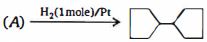
  • A
    $1$
  • B
    $2$
  • $3$
  • D
    $4$

Answer

Correct option: C.
$3$
c

Need a full question paper?

Generate a complete, print-ready paper with questions like this in minutes — across 16+ boards, with answer keys.

Start Generating Free

Similar questions

Molecular $AB$ has a bond length of $1.61\,\mathop A\limits^o $ and a dipole moment of $0.38\, D$. The fractional charge on each atom (absolute magnitude) is $(e_0\, = 4.802\times10^{-10}\, esu)$
In the long form of periodic table, the element having lowest ionisation potentials are present in
Alcoholic fermentation is brought about by the action of
$IUPAC$ name of :

$\begin{array}{*{20}{c}}
  {C{H_3} - C - CH - C - OC{H_3}} \\ 
  {||\,\,\,\,\,\,\,\,\,|\,\,\,\,\,\,\,\,\,\,\,\,||\,\,\,\,} \\ 
  {\,O\,\,\,\,\,\,C = O\,O\,\,\,\,\,} \\ 
  {|\,\,\,\,\,\,\,\,} \\ 
  {C{H_3}\,\,} 
\end{array}$

Which statement is correct?
Standard electrode potential of three metals $X , Y$ and $Z$ are $-1.2 \,V, + 0.5\, V$ and $- 3.0\, V$ respectively. The reducing power of these metals will be
Diatoms, microscopic organisms, are an abundant food source in the oceans producing carbohydrates from carbon dioxide and water by photosynthesis

$6CO_2 + 6H_2O + solar energy \to C_6H_{12}O_6+6O_2$

A blue whales gain $75\ kg$ of mass per day by feeding on krill. The whale must consume ten times this mass of krill each day. The krill must consume $10.0\ kg$ of diatoms to produce $1.0\ kg$ of krill. Assuming that the mass gain of a whale's life is due to the consumption of carbohydrates $(C_6H_{12}O_6)$ , calculate the moles of $CO_2$ that must be used by the diatoms to produce the carbohydrates consumed by a blue whale in a day

An alkene given two moles of $HCHO$, one mole of $C{O_2}$ and one mole of $C{H_3}COCHO$on ozonolysis. What is its structure 
On the basis of the thermochemical equations
$H_2O(g) + C(s) \to CO(g) + H_2(g) \,\,\,\Delta H = 131\,kJ$
$CO(g) + \frac {1}{2} O_2(g) \to CO_2(g) \,\,\,\Delta H = –282\,kJ$
$H_2(g) + \frac {1}{2} O_2(g) \to H_2O(g) \,\,\,\Delta H = –242\,kJ$
$C(s) + O_2(g) \to CO_2(g) \,\,\,\Delta H = X\,kJ$
The value of $X$ will be....$kJ$
Which of the following is diamagnetic transitional metal ion
