Question
A nanopeptide contains …….. peptide linkages

Answer

The peptide bond is formed between two amino acids by the elimination of a water molecule. A dipeptide contains one peptide linkage. A tripeptide contains two peptide linkages. Similarly, a nanopeptide contains $8$ peptide linkages.

Need a full question paper?

Generate a complete, print-ready paper with questions like this in minutes — across 16+ boards, with answer keys.

Start Generating Free

Similar questions

Number of molecules from the following which are exceptions to octet rule is. . . . 

$\mathrm{CO}_2, \mathrm{NO}_2, \mathrm{H}_2 \mathrm{SO}_4, \mathrm{BF}_3, \mathrm{CH}_4, \mathrm{SiF}_4, \mathrm{ClO}_2, \mathrm{PCl}_5,$ $\mathrm{BeF}_2, \mathrm{C}_2 \mathrm{H}_6, \mathrm{CHCl}_3, \mathrm{CBr}_4$
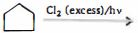
How many dichloro products are formed in the above reaction (including stereoisomers)?
The ammonia prepared by treating ammonium sulphate with calcium hydroxide is completely used by $\mathrm{NiCl}_2 .6 \mathrm{H}_2 \mathrm{O}$ to form a stable coordination compound. Assume that both the reactions are $100 \%$ complete. If $1584 \mathrm{~g}$ of ammonium sulphate and $952 \mathrm{~g}$ of $\mathrm{NiCl}_2 \cdot 6 \mathrm{H}_2 \mathrm{O}$ are used in the preparation, the combined weight (in grams) of gypsum and the nickelammonia coordination compound thus produced is $\qquad$ (Atomic weights in $\mathrm{g} \mathrm{mol}^{-1}: \mathrm{H}=1, \mathrm{~N}=14, \mathrm{O}=16, \mathrm{~S}=32, \overline{\mathrm{Cl}=35.5}, \mathrm{Ca}=40, \mathrm{Ni}=59$ )
A system absorb $600\,J $ of heat and work equivalent to $300\,J $ on its surroundings. The change in internal energy is......$J$
$Fe$ has been placed in the eighth group, the number of electrons in the outermost orbit is
In an experiment it showed that $10\ mL$ of $ 0.05\ M$ solution of chloride required $10\ mL$ of $0.1\ M$ solution of $AgNO_3,$ which of the following will be the formula of the chloride ($X$ stands for the symbol of the element other than chlorine)
To measure the quantity of $MnCl _2$ dissolved in an aqueous solution, it was completely converted to $KMnO _4$ using the reaction,

$MnCl _2+ K _2 S _2 O _8+ H _2 O \longrightarrow KMnO _4+ H _2 SO _4+ HCl$ (equation not balanced).

Few drops of concentrated $HCl$ were added to this solution and gently warmed. Further, oxalic acid ( $225 mg$ ) was added in portions till the colour of the permanganate ion disappeared. The quantity of $MnCl _2$ (in $mg$ ) present in the initial solution is. . . . . . . . . (Atomic weights in $g mol ^{-1}: Mn =55, Cl =35.5$ )

The value of magnetic quantum number of the outermost electron of $\mathrm{Zn}^{+}$ion is ..... .
$\begin{array}{*{20}{c}}
  {\begin{array}{*{20}{c}}
  {C{H_2} - OH} \\ 
  {|\,\,\,\,\,\,\,\,\,\,\,\,\,\,\,\,\,\,\,\,\,\,\,} 
\end{array}} \\ 
  {C{H_2} - OH} \\ 
  {|\,\,\,\,\,\,\,\,\,\,\,\,\,\,\,\,\,\,\,\,\,\,\,} \\ 
  {C{H_2} - SH} 
\end{array}$ ${ + \mathop {C{H_3}MgBr}\limits_{\left( {Excess} \right)}  \to xC{H_4}}$

What is the value of $x$ in the above reaction ?
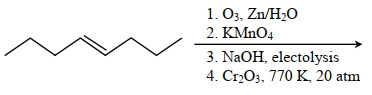
The number of $- CH _2$ - (methylene) groups in the product formed from the following reaction sequence is. . . . . . .