MCQ
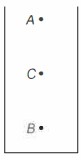
A narrow but tall cabin is falling freely near the earth's surface. Inside the cabin, two small stones $A$ and $B$ are released from rest (relative to the cabin). Initially $A$ is much above the centre of mass and $B$ much below the centre of mass of the cabin. A close observation of the motion of $A$ and $B$ will reveal that
  • A
    both $A$ and $B$ continue to be exactly at rest relative to the cabin
  • $A$ moves slowly upward and $B$ moves slowly downward relative to the cabin
  • C
    both $A$ and $B$ fall to the bottom of the cabin with constant acceleration due to gravity
  • D
    $A$ and $B$ move slightly towards each other vertically
Answer

Correct option: B.
$A$ moves slowly upward and $B$ moves slowly downward relative to the cabin
b
(b)

Acceleration due to gravity decreases as we move up from the earth's surface.

Let $A$ and $B$ are stones and $C$ is centre of mass of cabin. 'Their positions given are as shown below.

Clearly, $a_B > a_C > a_A$.

Hence, $B$ is accelerated more than $C$ and $A$ is accelerated less than $C$.

So, with time $A$ move upwards and $B$ move downwards relative to the cabin. So, option $(b)$ is correct.

Need a full question paper?

Generate a complete, print-ready paper with questions like this in minutes — across 16+ boards, with answer keys.

Start Generating Free

Similar questions

The pressure $P_{1}$ and density $d_{1}$ of diatomic gas $\left(\gamma=\frac{7}{5}\right)$ changes suddenly to $P _{2}\left(> P _{1}\right)$ and $d _{2}$ respectively during an adiabatic process. The temperature of the gas increases and becomes $......$ times of its initial temperature.$\left(\right.$ given $\left.\frac{ d _{2}}{ d _{1}}=32\right)$
A rigid spherical body is spinning around an axis without any external torque. Due to change in temperature, the volume increases by $1\%$. Its angular speed 
A particle moving with uniform speed in a circular path maintains:
A copper wire of length $1.0\, m$ and a steel wire of length $0.5\, m$ having equal cross-sectional areas are joined end to end. The composite wire is stretched by a certain load which stretches the copper wire by $1\, mm$. If the Young's modulii of copper and steel are respectively $1.0\times10^{11}\, Nm^{-2}$ and $2.0\times10^{11}\, Nm^{- 2}$, the total extension of the composite wire is ........ $mm$
A container with insulating walls is divided into two equal parts by a partition fitted with a valve. One part is filled with an ideal gas at a pressure $P$ and temperature $T$, whereas the other part is completely evacuated. If the valve is suddenly opened, the pressure and temperature of the gas will be
The moment of inertia of a solid cylinder about its own axis is the same as its moment of inertia about an axis passing through its centre of gravity and perpendicular to its length. The relation between its length $L$ and radius $R$ is
The heat capacity of a body depends on:
  1. The heat given.
  2. The temperature raised.
  3. The mass of the body.
  4. The material of the body.
If the screw on a screw-gauge is given six rotations, it moves by $3\; \mathrm{mm}$ on the main scale. If there are $50$ divisions on the circular scale the least count of the screw gauge is
Two bodies of mass $4\,kg$ and $6\,kg$ are attached to the ends of a string passing over a pulley. A $4\,kg$ mass is attached to the table top by another string. The tension in this string $T_1$ is equal to ......... $N$
$A$ thin uniform rod of mass $M$ and length $L$ has its moment of inertia $I_1$ about its perpendicular bisector. The rod is bend in the form of a semicircular arc. Now its moment of inertia through the centre of the semi circular arc and perpendicular to its plane is $I_2$. The ratio of $I_1 : I_2$ will be