Question
A narrow slit S transmitting light of wavelength $\lambda$ is placed a distance d above a large plane mirror as shown in figure (17-E1). The light coming directly from the slit and that coming after the reflection interfere at a screen $\sum$ placed at a distance D from the slit.
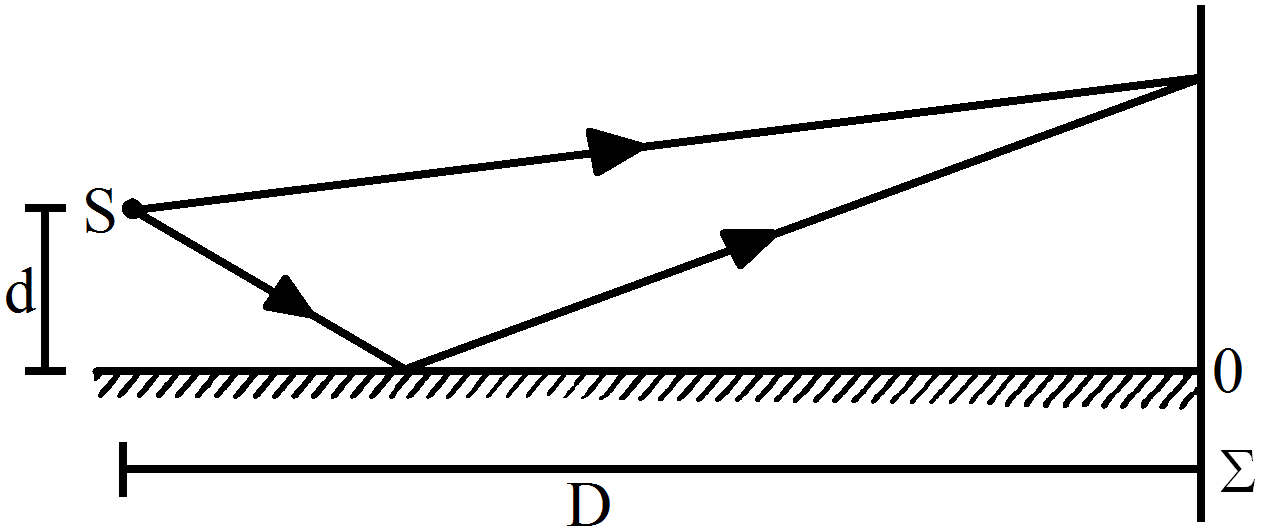
  1. What will be the intensity at a point just above the mirror, i.e., just above O?
  2. At what distance from 0 does the first maximum occur?
Answer

  1. Since, there is a phase difference of $\pi$ between direct light and reflecting light, the intensity just above the mirror will be zero.
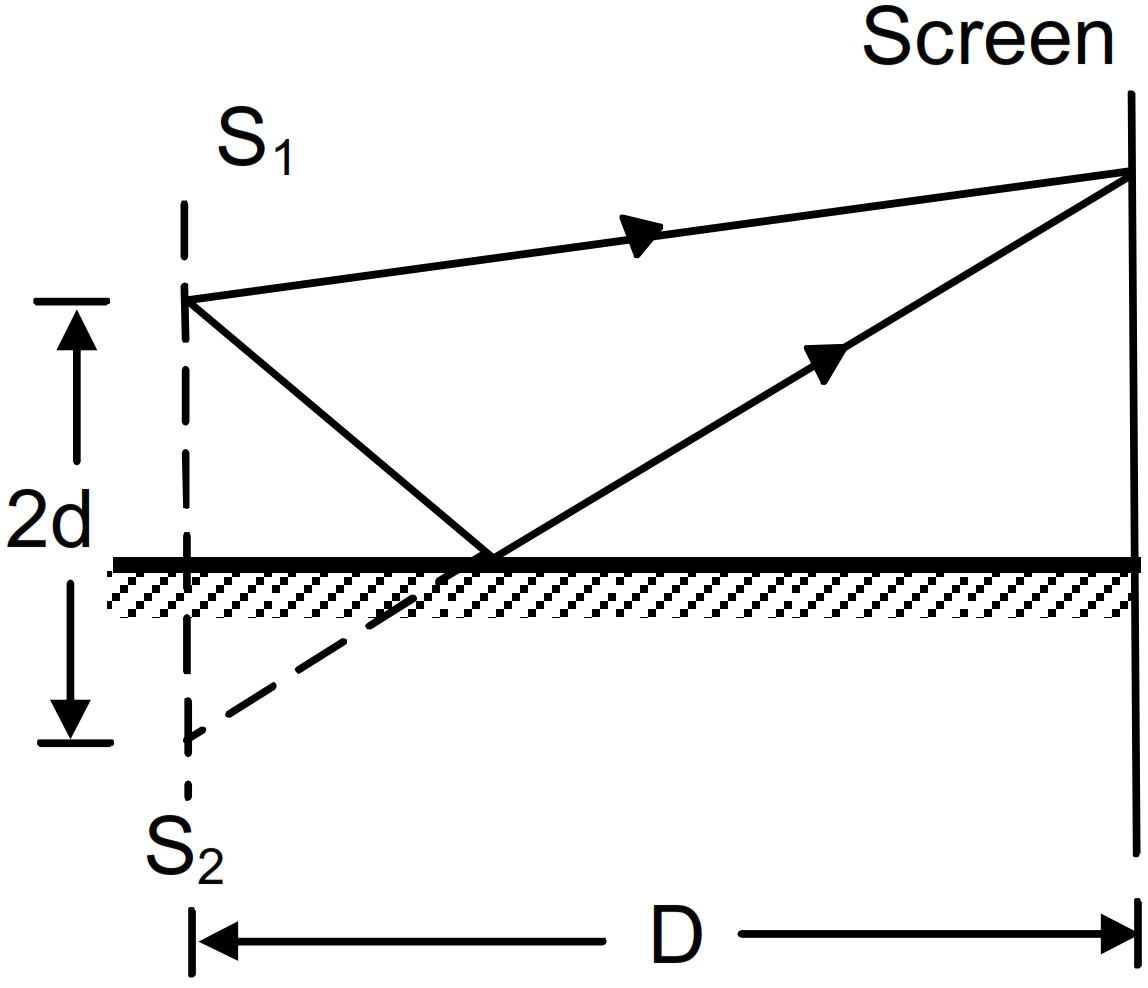
  2. Here, 2d = equivalent slit separation

D = Distance between slit and screen.

We know for bright fringe, $\Delta\text{x}=\frac{\text{y}\times2\text{d}}{\text{D}}=\text{n}\lambda$

But as there is a phase reversal of $\frac{\lambda}{2}.$

$\Rightarrow\frac{\text{y}\times2\text{d}}{\text{D}}+\frac{\lambda}{2}=\text{n}\lambda$

$\Rightarrow\frac{\text{y}\times2\text{d}}{\text{D}}=\text{n}\lambda-\frac{\lambda}{2}\Rightarrow\text{y}=\frac{\lambda\text{D}}{4\text{d}}$

Need a full question paper?

Generate a complete, print-ready paper with questions like this in minutes — across 16+ boards, with answer keys.

Start Generating Free

Similar questions

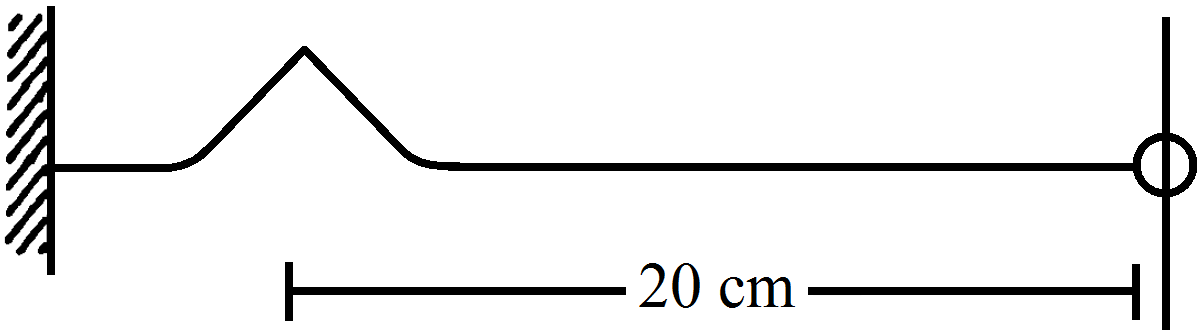
A string of linear mass density 0.5g/cm and a total length 30cm is tied to a fixed wall at one end and to a frictionless ring at the other end figure, The ring can move on a vertical rod. A wave pulse is produced on the string which moves towards the ring at a speed of 20cm/s. The pulse is symmetric about its maximum which is located at a distance of 20cm from the end joined to the ring.
  1. Assuming that the wave is reflected from the ends without loss of energy, find the time taken by the string to regain its shape.
  2. The shape of the string changes periodically with time. Find this time period.
  3. What is the tension in the string?

Can two equipotential surfaces cut each other?
Write any two distinguishing features between conductors, semiconductors and insulators on the basis of energy band diagrams.
Two narrow slits emitting iight in phase are separated by a distance of 1.0cm. The wavelength of the light is 5.0 × 10⁻⁷m. The interference pattern is observed on a screen placed at a distance of 1.0m.
  1. Find the separation between the consecutive maxima. Can you expect to distinguish between these maxima?
  2. Find the separation between the sources which will give a separation of 1.0mm between the consecutive maxima.
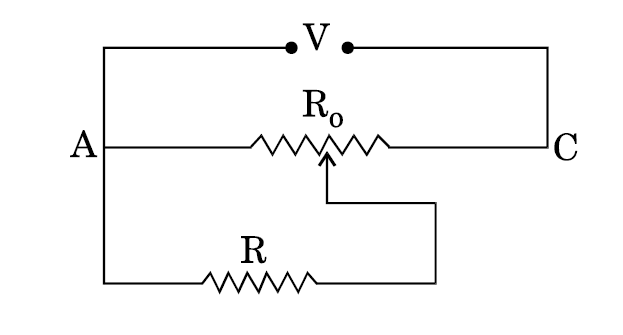
A resistance of R $\Omega$ draws current from a potentiometer as shown in the figure. The potentiometer has a total resistance RoΩ. A voltage V is supplied to the potentiometer. Derive an expression for the voltage across R when the sliding contact is in the middle of the potentiometer.

 A proton and an $\alpha$ particle move perpendicular to a magnetic field. Find the ratio of radii of circular paths described by them when both have (i) equal velocities, and (ii) equal kinetic energy.
A particle moves in a circle of radius 1.0cm at a speed given by v = 2.0t where v is in cm/s and t in seconds.
  1. Find the radial acceleration of the particle at t = 1s.
  2. Find the tangential acceleration at t = 1s.
  3. Find the magnitude of the acceleration at t = 1s.
Explain how Corpuscular theory predicts the speed of light in a medium, say, water, to be greater than the speed of light in vacuum. Is the prediction confirmed by experimental determination of the speed of light in water? If not, which alternative picture of light is consistent with experiment?
The number of electrons in an insulator is of the same order as the number of electrons in a conductor. What is then the basic difference between a conductor and an insulator?
  1. Drive the expression for electric field at a point on the equatorial line of an electric dipole.
  2. Depict the orientation of the dipole in (i) stable, (ii) unstable equilibrium in a uniform electric field.