Question
A narrow slit S transmitting light of wavelength $\lambda$ is placed a distance d above a large plane mirror as shown in figure (17-E1). The light coming directly from the slit and that coming after the reflection interfere at a screen $\sum$ placed at a distance D from the slit.
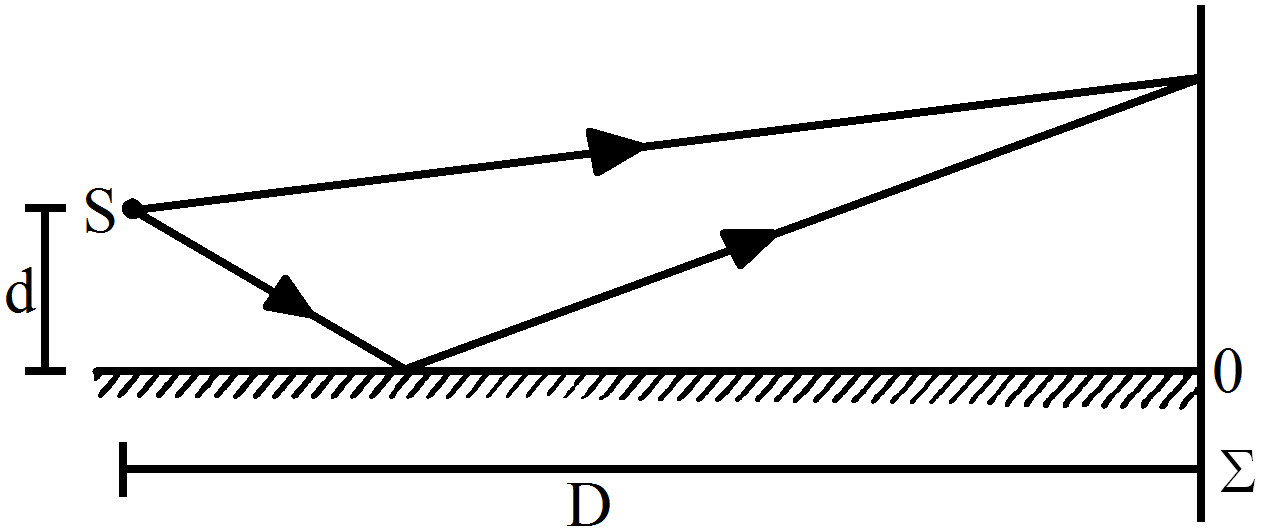
  1. What will be the intensity at a point just above the mirror, i.e., just above O?
  2. At what distance from 0 does the first maximum occur?
Answer

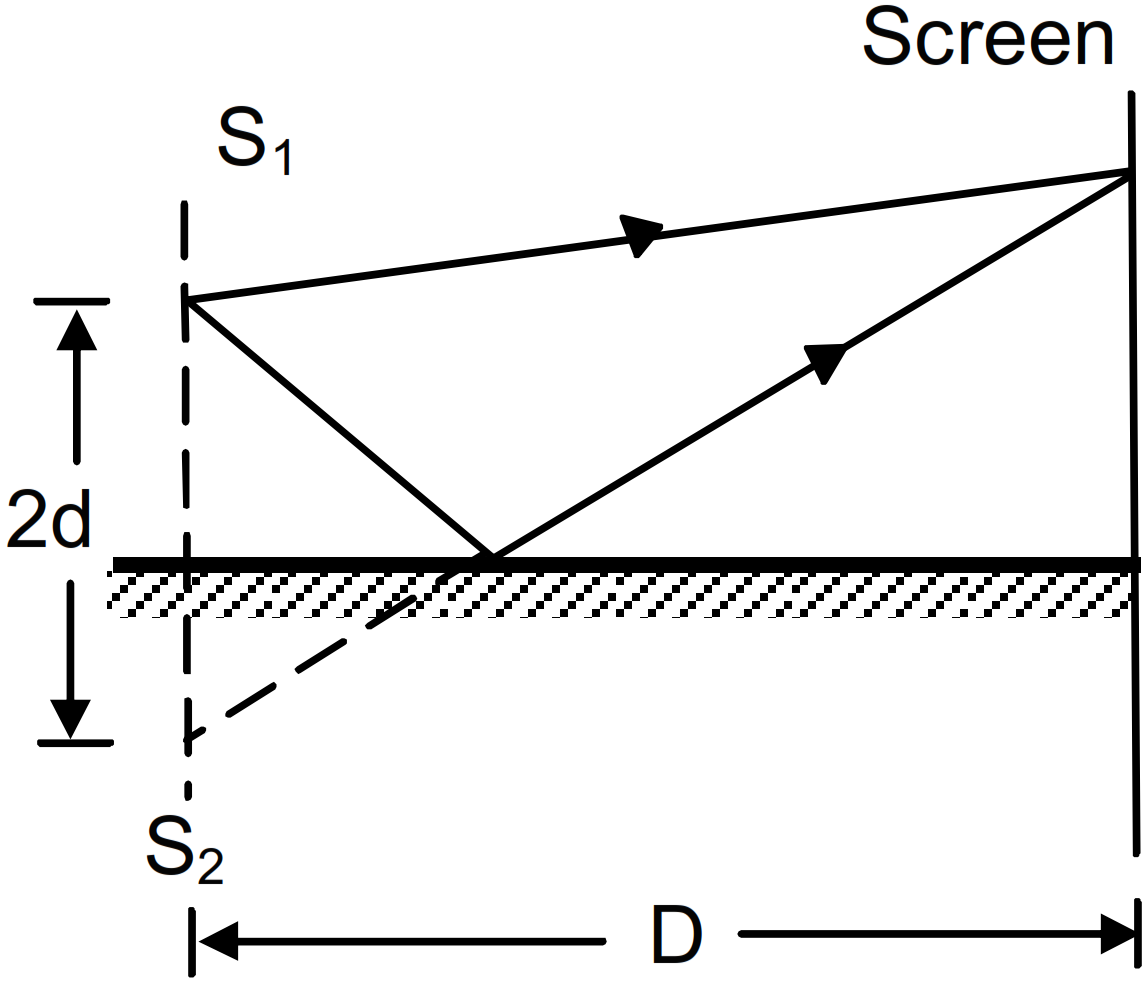
  1. Since, there is a phase difference of $\pi$ between direct light and reflecting light, the intensity just above the mirror will be zero.
  2. Here, 2d = equivalent slit separation

D = Distance between slit and screen.

We know for bright fringe, $\Delta\text{x}=\frac{\text{y}\times2\text{d}}{\text{D}}=\text{n}\lambda$

But as there is a phase reversal of $\frac{\lambda}{2}.$

$\Rightarrow\frac{\text{y}\times2\text{d}}{\text{D}}+\frac{\lambda}{2}=\text{n}\lambda$

$\Rightarrow\frac{\text{y}\times2\text{d}}{\text{D}}=\text{n}\lambda-\frac{\lambda}{2}\Rightarrow\text{y}=\frac{\lambda\text{D}}{4\text{d}}$

Need a full question paper?

Generate a complete, print-ready paper with questions like this in minutes — across 16+ boards, with answer keys.

Start Generating Free

Similar questions

Answer the following questions:
If χ-stands for the magnetic susceptibility of a given material, identity the class of materials for which $(\text{i})-1 \geq\text{X} < 0 (\text{ii}) 0< \text{X} < \varepsilon 0 (\varepsilon$ is a small positive number).
  1. Write the range of relative magnetic permeability of these materials.
  2. Draw the pattern of the magnetic field lines when these materials are placed on an strong magnetic field.
The gravitational force acting on a particle of 1g due to a similar particle is equal to 6.67 × 10⁻¹⁷N. Calculate the separation between the particles.
The drift current in a reverse-biased p-n junction increases in magnitude if the temperatu,re of the junction is increased. Explain this on the basis of creation of hole-electron pairs.
A spherical conductor of radius 12 cm has a charge of 1.6 × 10⁻⁷C distributed uniformly on its surface. What is the electric field:
  1. Inside the sphere
  2. Just outside the sphere
  3. At a point 18 cm from the centre of the sphere?
The radionuclide 11C decays according to
$^{11}_{6}\text{C}\rightarrow^{11}_{5}\text{B}+\text{e}^{+}+\text{v}:\ \text{T}_{1/2}=20.3 \text{ min}$
The maximum energy of the emitted positron is 0.960 MeV.
Given the mass values:
$\text{m}(^{11}_{6})=10=11.011434\text{ u and m}(^{11}_{6}\text{B})=11.009305\text {u}.$
calculate Q and compare it with the maximum energy of the positron emitted.
In a periodic table the average atomic mass of magnesium is given as 24.312 u. The average value is based on their relative natural abundance on earth. The three isotopes and their masses are $^{24}_{12}\text{Mg }23.98504\text{u}),^{25}_{12}\text{Mg }(24.98584\text{u})\text{ and }^{26}_{12}\text{Mg }(25.98259\text{u}).$ The natural abundance of $^{24}_{12}\text{Mg}\text{ is }78.99\%$ by mass. Calculate the abundances of other two isotopes.
Consider the situation of the previous problem. Find the average electric field energy stored in the capacitor and the average magnetic field energy stored in the coil.
In a hydrogen atom, the electron and proton are bound at a distance of about 0.53 $\mathring{\text{A}}$:
  1. Estimate the potential energy of the system in eV, taking the zero of the potential energy at infinite separation of the electron from proton.
  2. What is the minimum work required to free the electron, given that its kinetic energy in the orbit is half the magnitude of potential energy obtained in (a)?
  3. What are the answers to (a) and (b) above if the zero of potential energy is taken at 1.06 Å separation?
For a CE-transistor amplifier, the audio signal voltage across the collector resistance of 2 k$\Omega$ is 2 V. suppose the current amplification factor if the transistor is 100, find the input signal voltage and base current if the base resistance is 1 k$\Omega$.
A converging lens and a diverging mirror are placed at a separation of 15cm. The focal length of the lens is 25cm and that of the mirror is 40cm. Where should a point source be placed between the lens and the mirror so that the light, after getting reflected by the mirror and then getting transmitted by the lens, comes out parallel to the principal axis?