Question
A narrow slit S transmitting light of wavelength $\lambda$ is placed a distance d above a large plane mirror as shown in figure (17-E1). The light coming directly from the slit and that coming after the reflection interfere at a screen $\sum$ placed at a distance D from the slit.
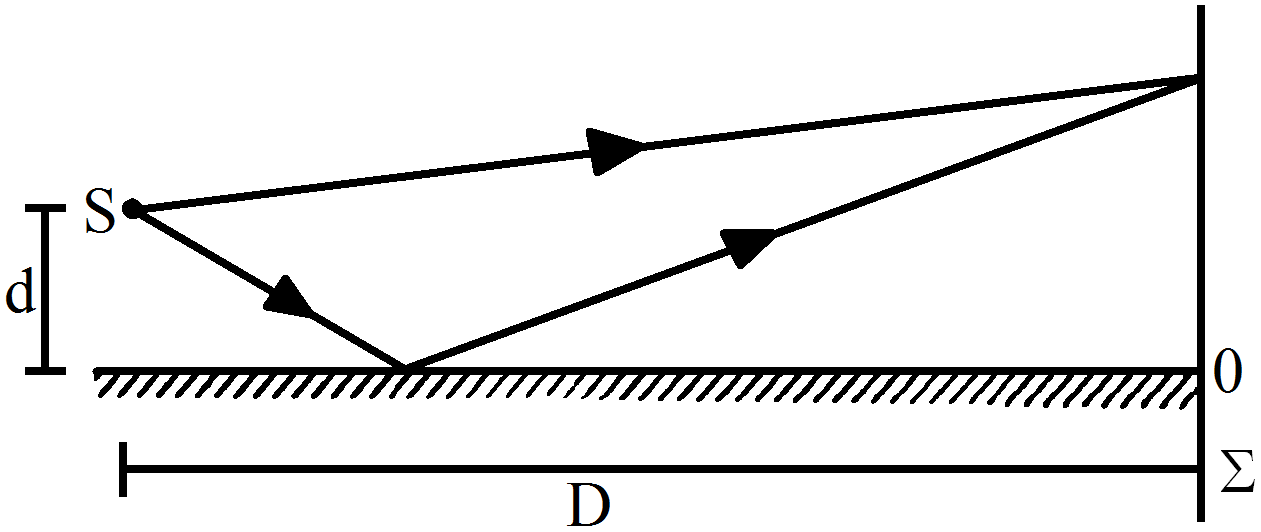
  1. What will be the intensity at a point just above the mirror, i.e., just above O?
  2. At what distance from 0 does the first maximum occur?
Answer

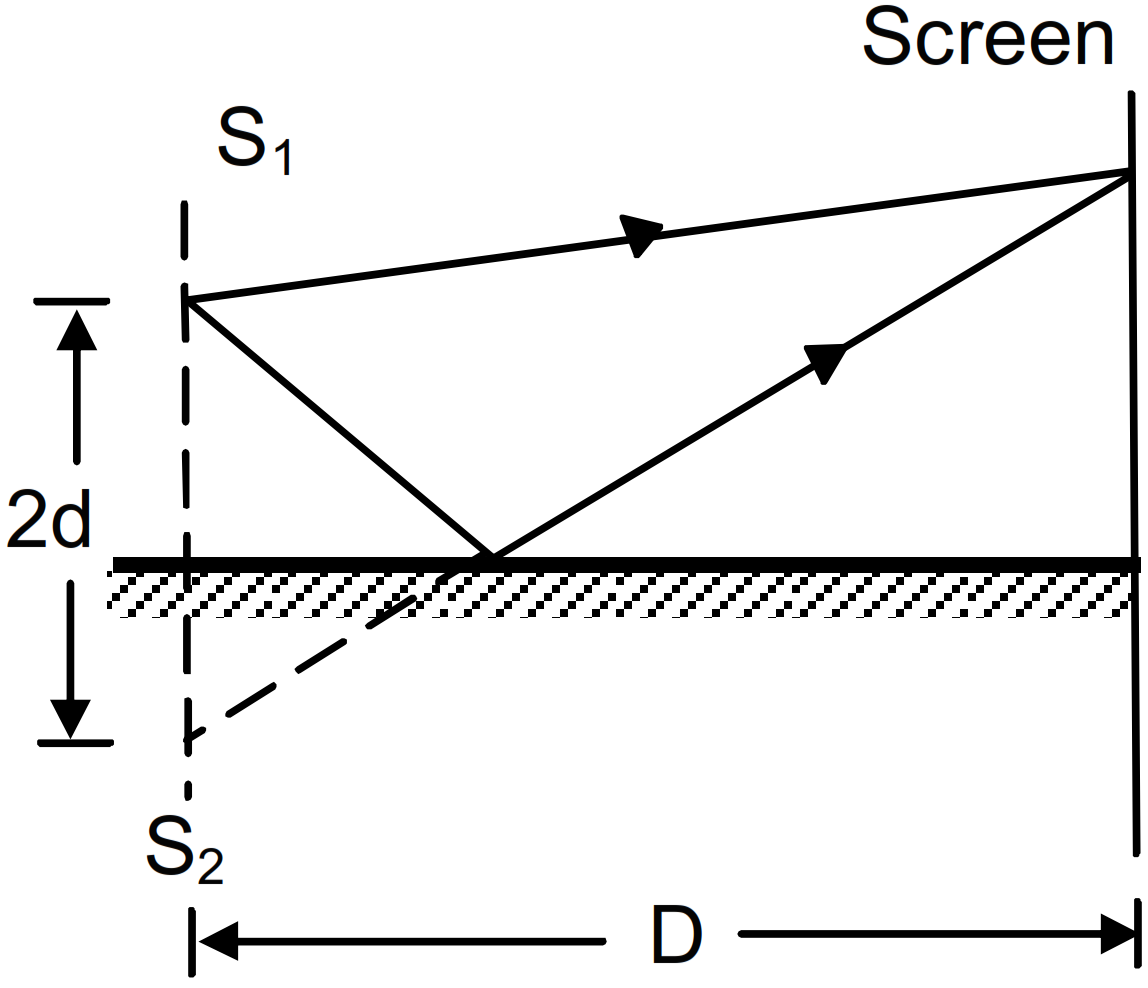
  1. Since, there is a phase difference of $\pi$ between direct light and reflecting light, the intensity just above the mirror will be zero.
  2. Here, 2d = equivalent slit separation


D = Distance between slit and screen.

We know for bright fringe, $\Delta\text{x}=\frac{\text{y}\times2\text{d}}{\text{D}}=\text{n}\lambda$

But as there is a phase reversal of $\frac{\lambda}{2}.$

$\Rightarrow\frac{\text{y}\times2\text{d}}{\text{D}}+\frac{\lambda}{2}=\text{n}\lambda$

$\Rightarrow\frac{\text{y}\times2\text{d}}{\text{D}}=\text{n}\lambda-\frac{\lambda}{2}\Rightarrow\text{y}=\frac{\lambda\text{D}}{4\text{d}}$

Need a full question paper?

Generate a complete, print-ready paper with questions like this in minutes — across 16+ boards, with answer keys.

Start Generating Free

Similar questions

Find the energy liberated in the reaction:
$^{223}Ra → ^{209}Pb + ^{14}C.$
The atomic masses needed are as follows.
$^{223}Ra$ $^{209}Pb$ $^{14}C$
$22.018u$ $208.981u$ $14.003u$
State the underlying principle of a potentiometer. Write two factors by which current sensitivity of a potentiometer can be increased. Why is a potentiometer preferred over a voltmeter for measuring the emf of a cell?
When can a charge act as a source of electromagnetic wave? How are the directions of electric and magnetic field vectors, in an electromagnetic wave related to each other and to the direction of propagation of the wave?
Which physical quantity, if any, has the same value for waves belonging to the different parts of the electromagnetic spectrum?
A convex lens made up of glass of refractive index 1.5 is dipped, in turn, in (i) a medium of refractive index 1.65, (ii) a medium of refractive index 1.33.
  1. Will it behave as a converging or a diverging lens in the two cases?
  2. How will its focal length change in the two media?
Define half-life of a radioactive sample. Which of the following radiations: $\alpha-$rays, $\beta-$rays and $\gamma-$rays.
  1. Are similar to X-rays.
  2. Are easily absorbed by matter.
  3. Travel with the greatest speed.
  4. Are similar in nature to cathode rays?
The force of surface tension acts tangentially to the surface whereas the force due to air pressure acts perpendicularly on the surface. How is then the force due to excess pressure inside a bubble balanced by the force due to the surface tension?
Radiation from hydrogen discharge tube falls on a cesium plate. Find the maximum possible kinetic energy of the photoelectrons. Work function of cesium is 1.9eV.
Equal masses of air are sealed in two vessels, one of volume $V_0$ and the other of volume $2V_0$. If the first vessel is maintained at a temperature 300K and the other at 600K, find the ratio of the pressures in the two vessels.
Find the angle of deviation suffered by the light ray shown in figure. The refractive index $\mu=1.5$ for the prism material.
  1. Three photo diodes $D_1, D_2$ and $D_3$ are made of semiconductors having band gaps of 2.5eV, 2eV and 3eV respectively. Which of them will not be able to detect light of wavelength 600nm?
  2. Why photodiodes are required to operate in reverse bias? Explain.