MCQ
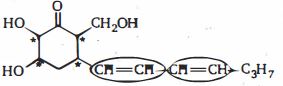
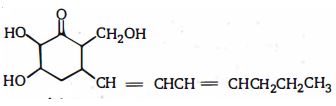
A naturally occurring substance has the constitution shown below. How many may  have this constitution ?
  • A
    $2$
  • B
    $8$
  • C
    $16$
  • $64$

Answer

Correct option: D.
$64$
d
molecule has $(1)$ chiral centre $= 4 , (2)\, C = C$ along which it can show $G. I = 2.$ Total stereoisomers $= 2^6 = 64$

Need a full question paper?

Generate a complete, print-ready paper with questions like this in minutes — across 16+ boards, with answer keys.

Start Generating Free

Similar questions

Which aqueous solution has minimum freezing point?
The $IUPAC$ name of the compound $\begin{array}{*{20}{c}}
  {\,\,\,\,\,\,\,OC{H_3}} \\ 
  | \\ 
  {C{H_3} - C{H_2} - CH - C{H_2} - OH} 
\end{array}$ is
The concentration of potassium ions inside a biological cell is at least twenty times higher than the outside. The resulting potential difference across the cell is important in several processes such as transmission of nerve impulses and maintaining the ion balance. A simple model for such a concentration cell involving a metal $\mathrm{M}$ is:

$\mathrm{M}(\mathrm{s}) \mid \mathrm{M}^{+}$(aq; $0.05$ molar) || $\mathrm{M}^{+}(\mathrm{aq}), 1$ molar) $\mid \mathrm{M}(\mathrm{s})$

For the above electrolytic cell the magnitude of the cell potential $\left|E_{\text {cell }}\right|=70 \mathrm{mV}$.

$1.$ For the above cell

$(A)$ $\mathrm{E}_{\text {cell }}<0 ; \Delta \mathrm{G}>0$ $(B)$ $\mathrm{E}_{\text {cell }}>0 ; \Delta \mathrm{G}<0$

$(C)$ $\mathrm{E}_{\text {cell }}<0 ; \Delta \mathrm{G}^{\circ}>0$ $(D)$ $\mathrm{E}_{\text {cell }}>0 ; \Delta \mathrm{G}^{\circ}>0$

$2.$ If the $0.05$ molar solution of $\mathrm{M}^{+}$is replaced by $0.0025$ molar $\mathrm{M}^{+}$solution, then the magnitude of the cell potential would be

$(A)$ $35 \mathrm{mV}$ $(B)$ $70 \mathrm{mV}$ $(C)$ $140 \mathrm{mV}$ $(D)$ $700 \mathrm{mV}$

Give the answer question $1,2.$ 

Osmotic pressure of a urea solution at ${10\,^o}C$ is $500\,\,mm.$ Osmotic pressure of the solution become $105.3 \,mm$. When it is diluted and temperature raised to ${25\,^o}C.$ The extent of dilution is .......... times
Which of the following hydride of nitrogen is most acidic in nature
Which one of the following pairs of compounds illustrates the law of multiple proportion
An amount of solid $N{H_4}HS$ is placed in a flask already containing ammonia gas at a certain temperature and $0.50$ $atm.$ pressure. Ammonium hydrogen sulphide decomposes to yield $N{H_3}$ and ${H_2}S$ gases in the flask. When the decomposition reaction reaches equilibrium, the total pressure in the flask rises to $0.84$ $atm$. The equilibrium constant for $N{H_4}HS$ decomposition at this temperature is
The $pH$ of ammonium phosphate solution, if $pK _{ a }$ of phosphoric acid and $pk _{ b }$ of ammonium hydroxide are $5.23$ and $4.75$ respectively, is ..... .
Which of the following pair is not isoelectronic species? (At. no. $Sm , 62 ; Er , 68: Yb , 70: Lu , 71 ; Eu , 63: Tb$, $65$; $\operatorname{Tm}, 69)$
The number of acyclic structural isomers (including geometrical isomers) for pentene are $......$