A negatively charged particle projected towards east is deflected towards north by a magnetic field. The field may be
Easy


Download our appand get started for free
Experience the future of education. Simply download our apps or reach out to us for more information. Let's shape the future of learning together!No signup needed.*
Similar Questions
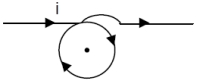
- 1In the figure, find out the magnetic field at $B$ (Given $I =2.5 \;A,r =5\, cm )$View Solution
- 2If a proton is projected in a direction perpendicular to a uniform magnetic field with velocity $v$ and an electron is projected along the lines of force, what will happen to proton and electronView Solution
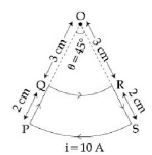
- 3A current loop, having two circular arcs joined by two radial lines is shown in the figure. It carries a current of $10\, A$. The magnetic field at point $O$ will be close toView Solution
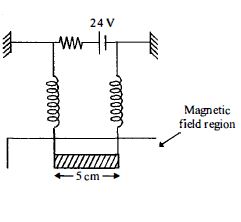
- 4The circuit in figure consists of wires at the top and bottom and identical springs as the left and right sides. The wire at the bottom has a mass of $10\, g$ and is $5\, cm$ long. The wire is hanging as shown in the figure. The springs stretch $0.5\, cm$ under the weight of the wire and the circuit has a total resistance of $12\, \Omega $. When the lower wire is subjected to a static magnetic field, the springs, stretch an additional $0.3\, cm$. The magnetic field isView Solution
- 5A steel wire has a magnetic moment $M.$ What will be its magnetic moment if it is bent into a semi-circular arc ?View Solution
- 6The radius of a circular loop is $r$ and a current $i$ is flowing in it. The equivalent magnetic moment will beView Solution
- 7View SolutionA moving coil sensitive galvanometer gives at once much more deflection. To control its speed of deflection
- 8A particle of mass $m,$ charge $Q$ and kinetic energy $K$ enters a transverse uniform magnetic field of induction $B.$ After $3$ $seconds$ the kinetic energy of the particle will be .......$K$View Solution
- 9A thin, straight conductor lies along the axis of a hollow conductor of radius $R$. The two carry equal currents in the same direction. The magnetic field $B$ is plotted against the distance $r$ from the axis. Which of the following best represents the resulting curve?View Solution
- 10Two concentric coplanar circular loops of radii ${r_1}$ and ${r_2}$ carry currents of respectively ${i_1}$ and ${i_2}$ in opposite directions (one clockwise and the other anticlockwise.) The magnetic induction at the centre of the loops is half that due to ${i_1}$ alone at the centre. If ${r_2} = 2{r_1}.$ the value of ${I_2}/{I_1}$ is....View Solution