Question
A neutron collides head on with a stationary hydrogen atom in ground state

Answer

The collision will be elastic if a part of the kinetic energy is used to excite the atom.

Suppose energ $\Delta E$ is used this way and $v_1$ and $v_2$ are the speed of the neutron and hydrogen atom after collision.

According to law of conservation of linear momentum, $m v=m v_1+m v_2 \ldots \ldots$. (Equation $1)$

According to the law of conservation of energv, $\frac{1}{2} m v^2=\frac{1}{2} m v_1^2+\frac{1}{2} m v_2^2+\Delta E_{\ldots} \ldots \ldots$ (Equation $2)$

From equation 1, we get $v^2=v_1^2+v_2^2+2 v_1 v_2$

From equation 2, we get $v^2=v_1^2+v_2^2+2(\Delta E / m)$

$\therefore 2 v _1 v _2=2(\Delta E / m )$

$\therefore\left(v_1-v_2\right)^2=\left(v_1+v_2\right)^2+\left(-4 v_1 v_2\right)$

$=v^2-(4 \Delta E / m)$

As $\left(v_1-v_2\right)$ must be real, hence $\left[v^2-(4 \Delta E / m)\right] \geq 0$

or $\frac{1}{2} m v^2 \geq 2 \Delta E$

The minimum energythat can be absorbed bythe hydrogen atom in ground state to go in an excited is

$10.2\,eV$. Thus, minimum kinetic energy of the neutron needed for an inelastic collision

$=2 \times 10.2=20.4\,eV$

Need a full question paper?

Generate a complete, print-ready paper with questions like this in minutes — across 16+ boards, with answer keys.
Start Generating Free

Similar questions

A planoconvex lens becomes an optical system of $28\, cm$ focal length when its plane surface is silvered and illuminated from left to right as shown in Fig $-A$. If the same lens is instead silvered on the curved surface and illuminated from other side as in Fig. $B$, it acts like an optical system of focal length $10 \,cm$. The refractive index of the material of lens is
Which of the following circuits correctly represents the following truth table ?

$\begin{array}{*{20}{c}}A&B&C\\0&0&0\\0&1&0\\1&0&1\\1&1&0\end{array}$
A drop of water volume $0.05\ cm^3$ is pressed between two glass-plates, as a consequence of which, it spreads between the plates. The area of contact with each plate is $40\ cm^2$ . If the surface tension of water is $70 \ dyne/cm$ , the minimum normal force required to seperate out the two glass plate in  newton is approximately...... $N$ (assuming angle of contact is zero) 
Work done in increasing the size of a soap bubble from a radius of $3\, cm$ to $5\,cm$ is  (Surface tension of soap solution $= 0.03 \,Nm^{-1})$
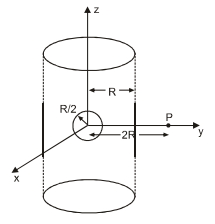
An infinitely long solid cylinder of radius $R$ has a uniform volume charge density $\rho$. It has a spherical cavity of radius $R / 2$ with its centre on the axis of the cylinder, as shown in the figure. The magnitude of the electric field at the point $P$, which is at a distance $2 \ R$ from the axis of the cylinder, is given by the expression $\frac{23 \rho R }{16 k \varepsilon_0}$. The value of $k$ is
A $2100 W$ continuous flow geyser (instant geyser) has water inlet temperature $= 10^o C$ while the water flows out at the rate of $20\,\, g/sec$. The outlet temperature of water must be about ....... $^oC$ 
A ball dropped from the top of tower falls first half height of tower in $10 \,s$. The total time spend by ball in air is ......... $s$ [Take $g=10 \,m / s ^2$ ]
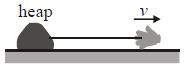
A heap of rope with mass density $\lambda $ (per unit length) lies on a table. You grab one end and pull horizontally with constant speed $v$ , as shown in figure. (Assume that the rope has no friction with itself in the heap.) The force that you must apply to maintain the constant speed $v$ is 
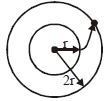
A satellite is in a circular equatorial orbit of radius $7000\,km$ around the Earth. If it is transferred to a circular orbit of double the radius then its angular momentum will be
A plane electromagnetic wave propagating along y-direction can have the following pair of electric field $(\vec{E} )$ and magnetic field $(\overrightarrow{ B })$ components.