MCQ
A neutron collides head on with a stationary hydrogen atom in ground state
  • If kinetic energy of the neutron is less than $13.6\,eV,$ collision must be elastic
  • B
    if kinetic energy of the neutron is less than $13.6\,eV,$ collision may be inelastic.
  • C
    inelastic collision takes place when initial kinetic energy of neutron is greater than $13.6\,eV.$
  • D
    perfectly inelastic collision cannot take place.

Answer

Correct option: A.
If kinetic energy of the neutron is less than $13.6\,eV,$ collision must be elastic
a
The collision will be elastic if a part of the kinetic energy is used to excite the atom.

Suppose energ $\Delta E$ is used this way and $v_1$ and $v_2$ are the speed of the neutron and hydrogen atom after collision.

According to law of conservation of linear momentum, $m v=m v_1+m v_2 \ldots \ldots$. (Equation $1)$

According to the law of conservation of energv, $\frac{1}{2} m v^2=\frac{1}{2} m v_1^2+\frac{1}{2} m v_2^2+\Delta E_{\ldots} \ldots \ldots$ (Equation $2)$

From equation 1, we get $v^2=v_1^2+v_2^2+2 v_1 v_2$

From equation 2, we get $v^2=v_1^2+v_2^2+2(\Delta E / m)$

$\therefore 2 v _1 v _2=2(\Delta E / m )$

$\therefore\left(v_1-v_2\right)^2=\left(v_1+v_2\right)^2+\left(-4 v_1 v_2\right)$

$=v^2-(4 \Delta E / m)$

As $\left(v_1-v_2\right)$ must be real, hence $\left[v^2-(4 \Delta E / m)\right] \geq 0$

or $\frac{1}{2} m v^2 \geq 2 \Delta E$

The minimum energythat can be absorbed bythe hydrogen atom in ground state to go in an excited is

$10.2\,eV$. Thus, minimum kinetic energy of the neutron needed for an inelastic collision

$=2 \times 10.2=20.4\,eV$
Need a full question paper?

Generate a complete, print-ready paper with questions like this in minutes — across 16+ boards, with answer keys.

Start Generating Free

Similar questions

In an insulator, the forbidden energy gap between valence band and conduction band is of the following order :
A rod of legth l rotates with a uniform angular velocity $\omega$ about its perpendicular bisector. A uniform magnetic field $B$ exists parallel to the axis of rotation. The potential difference between the two ends of the rod is:
Which is not an electrostatic phenomenon:
Assertion : If a compass needle be kept at magnetic north pole of the earth the compass needle may stay in any direction.

Reason : Dip needle will stay vertical at the north pole of earth

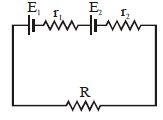
Under what conditions current passing through a resistance $R$ can be increased by short circuiting the battery of emf $E_2$. The internal resistances of the two batteries are $r_1$ and $r_2$ respectively
$A$ conducting ring of radius a is rotated about a point $O$ on its periphery as shown in the figure in a plane perpendicular to uniform magnetic field $B$ which exists everywhere. The rotational velocity is $\omega .$ Choose the correct statement $(s)$ related to the induced current in the ring
Energy released in the fission of a single $92^{\mathrm{U}^{235}}$ nucleus is 200 MeV. The fission rate of a $92^{\mathrm{U}^{235}}$ fuelled reactor operating at a power level of 5W is
A parallel beam of monochromatic light of wavelength $5000 \mathring A$ is incident normally on a single narrow slit of width $0.001 mm$. The light is focused by a convex lens on a screen placed on the focal plane. The first minimum will be formed for the angle of diffraction equal to
The amount of force exerted on a unit positive charge in an electric field is known as $........$?
A man who cannot see clearly beyond 5 m wants to see stars clearly. He should use a lens of focal length