Question
A neutron exerts a force on a proton which is:
- Gravitational.
- Electromagnetic.
- Nuclear.
- Weak.
Explanation:
A neutron exerts both the gravitational and nuclear forces on a proton.
The gravitational force can be seen between a neutron and a proton. However, its strength is negligible. The nuclear force is exerted only if the interacting particles are neutrons or protons or both. A neutron cannot exert electromagnetic force, because it is a neutral particle.
Generate a complete, print-ready paper with questions like this in minutes — across 16+ boards, with answer keys.
A far sighted man who has lost his spectacles, reads a book by looking through a small hole (3-4 mm) in a sheet of paper. The reason will be
|
(a) Because the hole produces an image of the letters at a longer distance |
|
(b) Because in doing so, the focal length of the eye lens is effectively increased |
|
(c) Because in doing so, the focal length of the eye lens is effectively decreased |
|
(d) None of these |
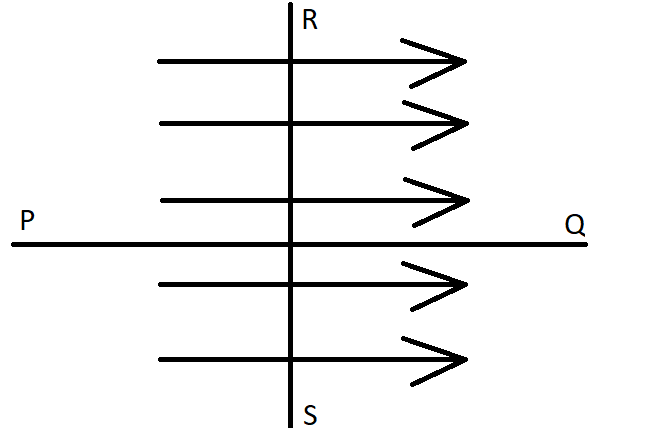
Light passes successively through two polarimeters tubes each of length 0.29m. The first tube contains dextro rotatory solution of concentration 60kgm–3 and specific rotation 0.01rad m2kg–1. The second tube contains laevo rotatory solution of concentration 30kg/m3 and specific rotation 0.02 radm2kg–1. The net rotation produced is
|
(a) 15° |
(b) 0° |
(c) 20° |
(d) 10° |
$\text{v}_\text{A}>\text{v}_\text{B}>\text{v}_\text{C}.$
$\text{v}_\text{A}<\text{v}_\text{B}<\text{v}_\text{C}$
$\text{v}_\text{A}=\text{v}_\text{B}=\text{v}_\text{C}$
$\text{v}_\text{B}=\frac{1}{2}(\text{v}_\text{A}+\text{v}_\text{C})$
A thin prism P1 with angle 4° and made from glass of refractive index 1.54 is combined with another thin prism P2 made from glass of refractive index 1.72 to produce dispersion without deviation. The angle of prism P2 is
|
(a) 2.6° |
(b) 3° |
(c) 4° |
(d) 5.33° |
The maximum focal length of the eye-lens of a person is greater than its distance from the retina. The eye is:
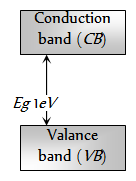
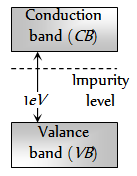
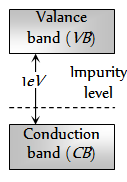
Which of the following energy band diagram shows the N-type semiconductor
|
(a)
|
(b)
|
(c)
|
(d) |
 →
→
