MCQ
A neutron exerts a force on a proton which is:
  • A
    Electromagnetic.
  • B
    Nuclear.
  • C
    Gravitational.
  • D
    Weak.

Answer

  1. Nuclear.
  2. Gravitational.

Explanation:

The gravitational forces are due to their masses in addition to nuclear forces inside the nucleus.

Need a full question paper?

Generate a complete, print-ready paper with questions like this in minutes — across 16+ boards, with answer keys.
Start Generating Free

Similar questions

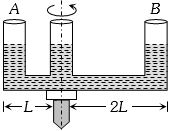
A given shaped glass tube having uniform cross section is filled with water and is mounted on a rotatable shaft as shown in figure. If the tube is rotated with a constant angular velocity $\omega $then
A body has its centre of mass at the origin. The x-coordinates of the particles:
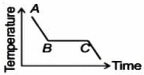
The portion $A B$ of the curve representing the state of matter denotes
Choose the correct length $( L )$ versus square of time period $\left( T ^2\right)$ graph for a simple pendulum executing simple harmonic motion.
A diatomic gas $(\gamma=1.4)$ does $400 J$ of work when it is expanded isobarically. The heat given to the gas in the process is ............ $J$
The displacement of a particle varies with time according to the relation:

$\text{y}=\text{a}\sin\omega\text{t}+\text{b}\cos\omega\text{t}$
  1. The motion is oscillatory but not S.H.M.
  2. The motion is S.H.M. with amplitude a + b.
  3. The motion is S.H.M. with amplitude a2 + b2
  4. The motion is S.H.M. with amplitude $\sqrt{\text{a}^2+\text{b}^2}.$
A bullet of mass $20\,g$ has an initial speed of $1\,ms^{-1}$ just before it starts penetrating a mud wall of thickness $20\,cm.$ If the wall offers a mean resistances of $2.5 \times 10^{-2}\,N,$ the speed of the bullet after emerging from the other side of the wall is close to .............. $\mathrm{ms}^{-1}$
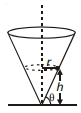
A particle describes a horizontal circle of radius $r$ on the smooth surface of an inverted cone as shown. The height of plane of circle above vertex is $h$. The speed of particle should be
The Young's modulus of a steel wire of length $6\,m$ and cross-sectional area $3\,mm ^2$, is $2 \times 11^{11}\,N / m ^2$. The wire is suspended from its support on a given planet. A block of mass $4\,kg$ is attached to the free end of the wire. The acceleration due to gravity on the planet is $\frac{1}{4}$ of its value on the earth. The elongation of wire is  (Take $g$ on the earth $=10$ $\left.m / s ^2\right):$
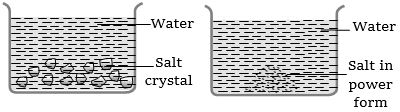
Out of the following, in which vessel will the temperature of the solution be higher after the salt is completely dissolved.