Question
A neutron initially at rest, decays into a proton, an electron and an antineutrino. The ejected electron has a momentum of 1.4 × 10⁻²⁶kg-m/s and the antineutrino 6.4 × 10⁻²⁷kg-m/s. Find the recoil speed of the proton:
  1. If the electron and the antineutrino are ejected along the same direction.
  2. If they are ejected along perpendicular directions. Mass of the proton = 1.67 × 10⁻²⁷kg.
Answer

Mass of proton = 1.67 × 10⁻²⁷

Let ‘Vp’ be the velocity of proton.

Given, momentum of electron = 1.4 × 10⁻²⁶kg m/sec.

Given, momentum of antineutrino = 6.4 × 10⁻²⁷kg m/sec

  1. The electron & the antineutrino are ejected in the same direction. As the total momentum is conserved the proton should be ejected in the opposite direction.

1.67 × 10⁻²⁷ × Vp = 1.4 × 10⁻²⁶ + 6.4 × 10-27 = 20.4 × 10⁻²⁷

$\Rightarrow\text{V}_{\text{p}}=\Big(\frac{20.4}{1.67}\Big)=12.2\text{m}/\text{sec}$ in the opposite direction.

  1. The electron & antineutrino are ejected $\perp$ to each other.

Total momentum of electron and antineutrino,

$=\sqrt{(14)^2+(6.4)^2}\times10^{-27}\text{kg}\ \ \text{m}/\text{s}=15.4\times10^{-27}\text{kg}\ \ \text{m}/\text{sec}$

Since, 1.67 × 10⁻²⁷, Vp = 15.4 × 10⁻²⁷kg m/s

So, Vp = 9.2m/s

Need a full question paper?

Generate a complete, print-ready paper with questions like this in minutes — across 16+ boards, with answer keys.

Start Generating Free

Similar questions

The cylindrical tube of a spray pump has a cross-section of 8.0cm2 one end of which has 40 fine holes each of diameter 1.0mm. If the liquid flow inside the tube is 1.5m min–1, what is the speed of ejection of the liquid through the holes?
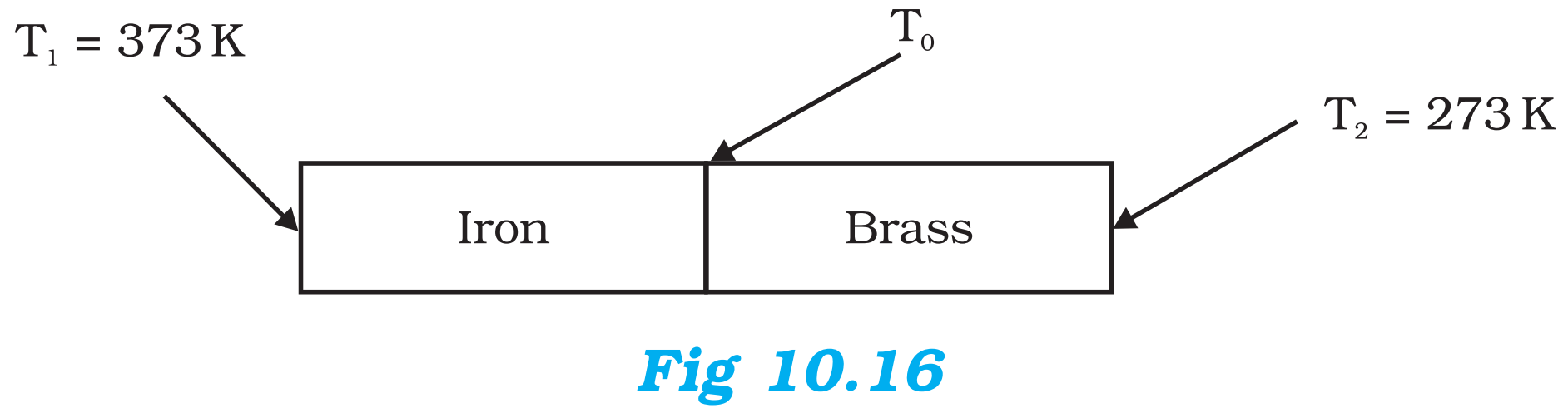
An iron bar $\left(L_1=0.1 m , A_1=\right.$ $\left.0.02 m ^2, K_1=79 W m ^{-1} K ^{-1}\right)$ and a brass bar $\left(L_2=0.1 m , A_2=0.02 m ^2\right.$, $K_2=109 W m ^{-1} K ^{-1}$ ) are soldered end to end as shown in Fig. 10.16. The free ends of the iron bar and brass bar are maintained at $373 K$ and $273 K$ respectively. Obtain expressions for and hence compute (i) the temperature of the junction of the two bars, (ii) the equivalent thermal conductivity of the compound bar, and (iii) the heat current through the compound bar.
Image
A cubical metal block of edge 12cm floats in mercury with one fifth of the height inside the mercury. Water is poured till the surface of the block is just immersed in it. Find the height of the water column to be poured. Specific gravity of mercury = 13.6.
A current of 1.0A exists in a copper wire of cross-section 1.0mm2. Assuming one free electron per atom, calculate the drift speed of the free electrons in the wire. The density of copper is 9000kg/m-3.
One mole of an ideal gas undergoes a process $\text{p}=\frac{\text{p}_0}{1+\Big(\frac{\text{V}}{\text{V}_0}\Big)^2}$ where P0 and V0 are constants. Find the temperature of the gas when V = V0.
Two bodies A and B of masses 5kg and 10kg in contact with each other rest on a table against a rigid wall (Fig.). The coefficient of friction between the bodies and the table is 0.15. A force of 200N is applied horizontally to A. What are (a) the reaction of the partition (b) the action-reaction forces between A and B? What happens when the wall is removed? Does the answer to (b) change, when the bodies are in motion? Ignore the difference between µs and µk.

A man runs across the roof-top of a tall building and jumps horizontally with the hope of landing on the roof of the next building which is of a lower height than the first. If his speed is 9m/s, the (horizontal) distance between the two buildings is 10m and the height difference is 9m, will he be able to land on the next building? (take g = 10m/s2).
The bottom of a dip on a road has a radius of curvature $R$. A rickshaw of mass $M$ left a little away from the bottom oscillates about the dip. Deduce an expression for the period of oscillation.
Find the wavelength of the radiation emitted by hydrogen in the transitions (a) n = 3 to n= 2, (b) n = 5 to n = 4 and (c) n = 10 to n = 9.
The electric field in a region is given by $\overrightarrow{\text{E}}=\frac{\text{E}_0\text{x}}{\text{l}}\vec{\text{i}}.$ Find the charge contained inside a cubical volume bounded by the surfaces x = 0, x = a, y = 0, y = a, z = 0 and z = a. Take E0 = 5 × 10³Nc-1, l = 2cm and a = 1cm.