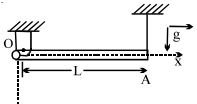
$X_{c m}=\frac{\int x d m}{\int d m}=\frac{\int_{0}^{L} x \times \lambda_{o} x d x}{\int_{0}^{L} \lambda_{o} x d x}$
$=\frac{\lambda_{o} \int_{o}^{L} x^{2} d x}{\lambda_{o} \int_{o}^{L} x d x}$
$X_{c m}=\frac{\left(\frac{x^{3}}{3}\right)_{o}^{L}}{\left(\frac{x^{2}}{2}\right)_{o}^{L}}=\frac{2}{3} \times \frac{L^{2}}{L^{2}}=\frac{2 L}{3}$
Moment of inertia about $0$
$d I=d m \times x^{2}$
$I=\int d m x^{2}$
$=\int_{o}^{\bar{L}} \lambda_{o} x d x \times x^{2}$
$=\lambda_{o} \int x^{3} d x$
$=\frac{\lambda^{o}}{4}\left(x^{4}\right)_{o}^{2}$
$I=\frac{\lambda_{o}}{4} \times L^{4}$
$\&$ mass
$=$ $\int_{o}^{L} \lambda_{o} x d x=\frac{\lambda_{o}}{2}\left(x^{2}\right)_{0}^{L}$
$=\frac{\lambda_{2}}{2} \times L^{2}$
Torque about the center, $m g \times \frac{2 L}{3}=I \alpha$
$=>\frac{\lambda_{0}}{2} \times L^{2} g \times \frac{2 L}{3}=\frac{\lambda_{0}}{4} \times L^{4} \alpha$
$=>\frac{\lambda_{o} g L^{3}}{3}=\lambda_{o} \alpha \frac{L^{4}}{4}$
$=>\frac{\lambda_{o} g}{3}=\frac{\lambda_{o} \alpha L}{4}$
$=>\alpha=\frac{4 g}{3 L}$