Question
 A normal eye is not able to see objects closer than 25cm because:

Answer

  1. The eye is not able to decrease the focal length beyond a limit.
Explanation:
The ciliary muscles adjust the focal length to form an image on the retina, but the muscles cannot be strained beyond a limit. Hence, if the object is brought too close to the eye, the focal length cannot be adjusted to form the image on the retina.

Need a full question paper?

Generate a complete, print-ready paper with questions like this in minutes — across 16+ boards, with answer keys.
Start Generating Free

Similar questions

A P-type semiconductor has acceptor levels $57\ meV$ above the valence band. The maximum wavelength of light required to create a hole is $($Planck’s constant $h = 6.6 \times 10^{-34} J-s)$
If $L$ is the coherence length and $c$ the velocity of light, the coherent time is
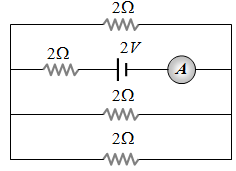
The reading of the ammeter as per figure shown is
A convex lens is made of a material having refractive index $1.2.$ Both the surfaces of the lens are convex. If it is dipped into water $(\mu=1.33),$ it will behave like:
Modern atomic mass scale is based on the mass of:
The electromagnetic waves of frequency 2 MHz to 30 MHz are (a) In ground wave propagation(b) In sky wave propagation(c) In microwave propagation(d) In satellite communication
   
   
A coil of negligible resistance is connected in series with a $90\Omega$ resistor across a 120 V, 60 Hz line. An ac voltmeter reads 90 V across the resistance, then the inductance of the coil is approximately.
An electromagnet:
The magnetic susceptibility does not depend upon the temperature in(a) Ferrite substances(b) Ferromagnetic substances(c) Diamagnetic substances(d) Paramagnetic substances
   
   
Assertion  :   Magnetism is relativistic.
Reason      : When we move along with the charge so that there is no motion relative to us, we find no magnetic field associated with the charge.(a) If both assertion and reason are true and the reason is the correct explanation of the assertion.(b) If both assertion and reason are true but reason is not the correct explanation of the assertion.(c) If assertion is true but reason is false.(d) If the assertion and reason both are false.