Question
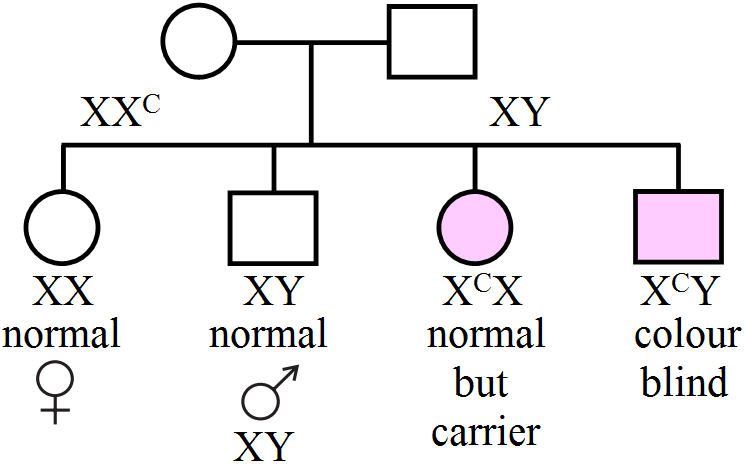
A normal visioned woman, whose father is colour blind, marries a normal visioned man. What would be the probability of her (a) sons (b) daughters to be colour blind? Explain with the help of pedigree chart.
Answer


All daughters are normal visioned and 50% of sons are likely to be colour blind.

Need a full question paper?

Generate a complete, print-ready paper with questions like this in minutes — across 16+ boards, with answer keys.

Start Generating Free

Similar questions

A pea plant bearing axial flowers is crossed with a pea plant bearing terminal flowers. The cross is carried out to find the genotype of the pea plant bearing axial flowers. Work out the cross to show the conclusions you arrive at.
Describe the experiment carried out by Hershey and Chase. Write the conclusion they arrived at.
What is the major advantage of producing plants by micropropagation?
Match the codons in Column I with the amino acids in Column II.
S. No.
Column I
 
Column II
A
UUU
1
Termination
B
AUG
2
Tyrosine
C
UAA
3
Phenylalanine
D
AGU
4
Methionine
E
UAC
5
Serine
Answer the following questions:
Mention the functions of acrosome and middle piece.
How does the transmission of each of the following diseases take place?
  1. Amoebiasis.
  2. Malaria.
  3. Ascariasis.
  4. Pneumonia.
Name the functions of the following:
  1. Corpus luteum.
  2. Endometrium.
  3. Acrosome.
  4. Sperm tail.
  5. Fimbriae.
Observe the representation of genes involved in the lac operon given below.

  1. Identify the region where the repressor protein will attach normally.
  2. Under certain conditions repressor is unable to attach at this site. Explain.
  3. If repressor fails to attach to the said site what products will be formed by z, y and a?
  4. Analyse why this kind of regulation is called negative regulation.
Study the following flow chart. Name the hormones involved at each stage. Explain their functions.
i. How are the characteristic features of pollen, anther and stigma of a maize plant suited for pollination by wind?
ii. How do you justify that:
1. Pollen grains are recovered from fossils?
2. Micropyle remains as a small pore in the seed coat of a fully developed seed?
