MCQ
A nuclear reaction with positive Q value is:
- AEndothermic
- BExothermic
- CEither endothermic or exothermic
- DNeither endothermic nor exothermic
Explanation:
An exothermic reaction is that in which heat is released.
An exothermic reaction is that in which heat is absorbed.
In a nuclear reaction, if the mass of the product nucleus and outgoing particle is less than the mass of the target nucleus and bombarding particle, then energy is released (exothermic reaction), and Q-value is +ve.
Generate a complete, print-ready paper with questions like this in minutes — across 16+ boards, with answer keys.
Following is the relation between current and charge  then value of VL will be
|
(a) |
(b) |
(c) |
(d) |
If particles are moving with same velocity, then maximum de-Broglie wavelength will be for
|
(a) Neutron |
(b) Proton |
(c) b-particle |
(d) α - particle |
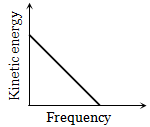
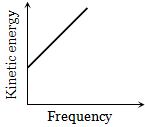
According to Einstein's photoelectric equation, the graph between the kinetic energy of photoelectrons ejected and the frequency of incident radiation is
(a)
|
(b)
|
(c)
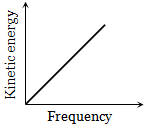
|
(d)
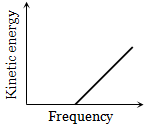
|
50 Ω and 100 Ω resistors are connected in series. This connection is connected with a battery of 2.4 volts. When a voltmeter of 100 Ω resistance is connected across 100 Ω resistor, then the reading of the voltmeter will be
|
(a) 1.6 V |
(b) 1.0 V |
(c) 1.2 V |
(d) 2.0 V |
Half life of  is 5 days. If we start with 50,000 atoms of this isotope, the number of atoms left over after 10 days is
|
(a) 5,000 |
(b) 25,000 |
(c) 12,500 |
(d) 20,000 |
In the experiment of potentiometer, at balance, there is no current in the
|
(a) Main circuit |
|
(b) Galvanometer circuit |
|
(c) Potentiometer circuit |
|
(d) Both main and galvanometer circuits |


