Question
A nucleus is at rest in the laboratory frame of reference. Show that if it disintegrates into two smaller nuclei the products must move in opposite directions.

Answer

Let, Mass of parent nucleus $=\mathrm{m}$ (At rest) Mass of two daughter nuclei $=\mathrm{m}_1$, and $\mathrm{m}_2$ Initial momentum of the system (parent nucleus) $=0$ Let, Velocity of first daughter nucleus having mass $m_1=v_1$ Velocity of second daughter nucleus having mass $m_2=v_2$ Total linear momentum of the system after disintegration $=\left(m_1 v_1+m_2 v_2\right)$ According to the law of conservation of momentum: Total initial momentum $=$ Total final momentum $0=\left(m_1 \mathrm{v}_1+m_2 \mathrm{v}_2\right) \mathbf{v}_1=\frac{-\mathrm{m}_2 \mathbf{v}_2}{\mathrm{~m}_1}$ Here, the negative sign indicates that the fragments of the parent nucleus move in directions opposite to each other.

Need a full question paper?

Generate a complete, print-ready paper with questions like this in minutes — across 16+ boards, with answer keys.
Start Generating Free

Similar questions

An air chamber of volume V has a neck area of cross section a into which a ball of mass m just fits and can move up and down without any friction (Fig.). Show that when the ball is pressed down a little and released , it executes SHM. Obtain an expression for the time period of oscillations assuming pressure-volume variations of air to be isothermal [see Fig.].
A plane electromagnetic wave is passing through a region. Consider (a) electric field (b) magnetic field (c) electrical energy in a small volume and (d) magnetic energy in a small volume. Construct the pairs of the quantities that oscillate with equal frequencies.
If a number of little droplets of water of surface tension S, all of the same radius r combine to form a single drop of radius R and the energy released is converted into K.E. Find the velocity acquired by the bigger drop. If the energy released is converted into heat, find the rise in temperature.
A sphercial capacitor is made of two conducting spherical shells of radii a and b. The space between the shells is filled with a dielectric of dielectric constant K up to a radius c as shown in figure. Calculate the capacitance.
In nature, the failure of structural members usually result from large torque because of twisting or bending rather than due to tensile or compressive strains. This process of structural breakdown is called buckling and in cases of tall cylindrical structures like trees, the torque is caused by its own weight bending the structure. Thus the vertical through the centre of gravity does not fall within the base. The elastic torque caused because of this bending about the central axis of the tree is given by $\frac{\text{Y}\pi\text{r}^4}{4\text{R}}.$ Y is the Young’s modulus, r is the radius of the trunk and R is the radius of curvature of the bent surface along the height of the tree containing the centre of gravity (the neutral surface). Estimate the critical height of a tree for a given radius of the trunk.
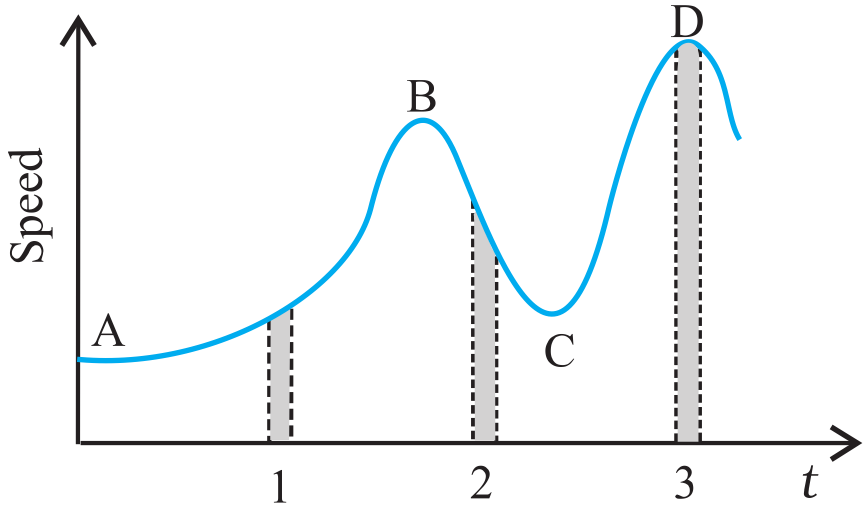
Gives a speed-time graph of a particle in motion along a constant direction. Three equal intervals of time are shown. In which interval is the average acceleration greatest in magnitude? In which interval is the average speed greatest? Choosing the positive direction as the constant direction of motion, give the signs of v and a in the three intervals. What are the accelerations at the points A, B, C and D?
Two identical masses, one at rest and the other moving, undergo elastic oblique collision. Prove that they will move at right angles to each other after collision.
Write Newton's law of cooling and state its necessary conditions. Derivation of Newton's law of cooling from Stefan's law.
What is meant by viscosity? Explain by giving examples. Describe the effect of temperature on viscosity.
The nearest star to our solar system is $4.29$ light years away. How much is this distance in terms of parsecs? How much parallax would this star (named Alpha Centauri) show when viewed from two locations of the Earth six months apart in its orbit around the Sun?