MCQ
A nucleus $_n{X^m}$emits one $\alpha $ and one $\beta $ particles. The resulting nucleus is
  • A
    $_n{X^{m - 4}}$
  • B
    $_{n - 2}{Y^{m - 4}}$
  • C
    $_{n - 4}{Z^{m - 4}}$
  • $_{n - 1}{Z^{m - 4}}$

Answer

Correct option: D.
$_{n - 1}{Z^{m - 4}}$
d
(d)$_{n}{{X}^{m}}{{\xrightarrow{\alpha }}_{n-2}}{{X}^{m-4}}{{\xrightarrow{-\beta }}_{n-1}}{{X}^{m-4}}$

Need a full question paper?

Generate a complete, print-ready paper with questions like this in minutes — across 16+ boards, with answer keys.
Start Generating Free

Similar questions

A $10\, ohm$ resistance, $5 \,mH$ coil and $10$ $\mu$$F$ capacitor are joined in series. When a suitable frequency alternating current source is joined to this combination, the circuit resonates. If the resistance is halved, the resonance frequency
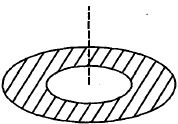
A thin disc of radius $b = 2a$  has a concentric hole of radius $'a'$ in it (see figure). It carries uniform surface charge $'\sigma '$ on it. If the electric field on its axis at height $'h'$ $(h << a)$ from its centre is given as $'Ch'$ then value of $'C'$ is
The energy of an electromagnetic wave contained in a small volume oscillates with
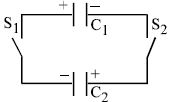
Two capacitors $C_1 = 4\  \mu F$ and $C_2 = 2\ \mu F$ are charged to same potential $ V = 500\  Volt$, but with opposite polarity as shown in the figure. The switches $S_1$ and $S_2$ are closed.
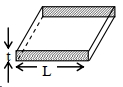
Consider a thin square sheet of side $\mathrm{L}$ and thickness $\mathrm{t}$, made of a material of resistivity $\rho$. The resistance between two opposite faces, shown by the shaded areas in the figure is
In the middle of the depletion layer of a reverse-biased PN junction, the
For a radioactive material, its activity $A$ and rate of change of its activity $R$ are defined as $A=-\frac{d N}{d t}$ and $R=-\frac{d A}{d t}$, where $N(t)$ is the number of nuclei at time $t$. Two radioactive sources $P$ (mean life $\tau$ ) and $Q$ (mean life $2 \tau$ ) have the same activity at $t=0$. Their rates of change of activities at $t=2 \tau$ are $R_p$ and $R_Q$, respectively. If $\frac{R_p}{R_Q}=\frac{n}{e}$, then the value of $n$ is
Outside a nucleus
The hyperfine lines in the spectrum is related to:
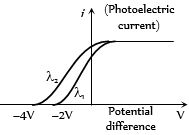
The maximum value of stopping potential in the following diagram is .......... $V$