Question
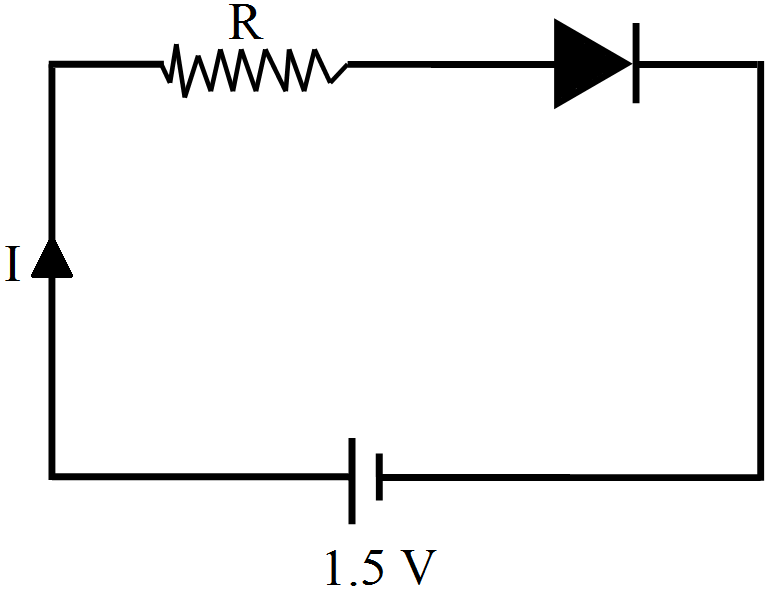
A p-n junction germanium diode when forward biased has a drop of 0.3V which is assumed to be independent of current. The current in excess of 10mA through the diode produces a large Joule-heating which damages (burns) the diode. If we want to use a 1.5V battery to forward-bias the diode, what should be the value of resistor used in series with the diode, so that the maximum current does not exceed 6mA?
Answer

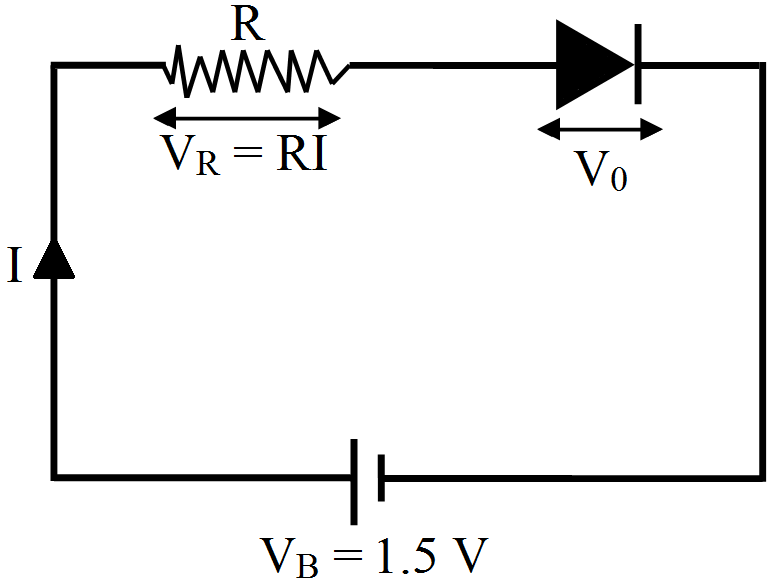
The basic equation of diode-circuit is:
$\text{RI}+\text{V}_0=\text{V}_\text{B}$
$\Rightarrow\text{R}=\frac{\text{V}_\text{E}-\text{V}_0}{\text{I}}$
Here, $\text{V}-\text{B}=1.5\text{V},\text{V}_0$
$=0.3\text{V},\text{I}=5\text{mA}=6\times10^{-3}\text{A}$
$\therefore\text{R}=\frac{1.5-0.3}{6\times10^{-3}}$
$=\frac{1.2\times10^{3}}{6}$
$=0.2\times10^3\Omega$
$=200\Omega$

Need a full question paper?

Generate a complete, print-ready paper with questions like this in minutes — across 16+ boards, with answer keys.

Start Generating Free

Similar questions

Use the mirror equation to show that.
  1. An object placed between f and 2f of a concave mirror produces a real image beyond 2f.
  2. A convex mirror always produces a virtual image independent of the location of the object.
  3. An object placed between the pole and focus of a concave mirror produces a virtual and enlarged image.
In a photoelectric experiment, the collector plate is at 2.0V with respect to the emitter plate made of copper ($\phi$ - 4.5eV). The emitter is illuminated by a source of monochromatic light of wavelength 200 run. Find the minimum and maximum kinetic energy of the photoelectrons reaching the collector.
You are given n resistors each of resistance r. They are first connected to get the minimum possible resistance. In the second case, these are again connected differently to get the maximum possible resistance. Calculate the ratio between minimum and maximum values of resistance so obtained.
A long charged cylinder of linear charge density $+\lambda_1$ is surrounded by a hollow coaxial conducting cylinder of linear charge density $-\lambda_2$. Use Gauss’s law to obtain expressions for the electric field at a point (i) in the space between the cylinders, and (ii) outside the larger cylinder.
Consider a simple harmonic motion of time period T. Calculate the time taken for the displacement to change value from half the amplitude to the amplitude.
A person travelling by a car moving at 100km/h finds that his wristwatch agrees with the clock on a tower A. By what amount will his wristwatch lag or lead the clock on another tower B, 1000km (in the earth's frame) from the tower A when the car reaches there?
The force of surface tension acts tangentially to the surface whereas the force due to air pressure acts perpendicularly on the surface. How is then the force due to excess pressure inside a bubble balanced by the force due to the surface tension?
Whenever a photon is emitted by hydrogen in Balmer series, it is followed by another photon in Lyman series. What wavelength does this latter photon correspond to?
A transformer has 50 turns in the primary and 100 in the secondary. If the primary is connected to a 220V DC supply, what will be the voltage across the secondary?
Show that the ratio of the magnetic dipole moment to the angular momentum (l = mvr) is a universal constant for hydrogen-like atoms and ions. Find its value.