Question
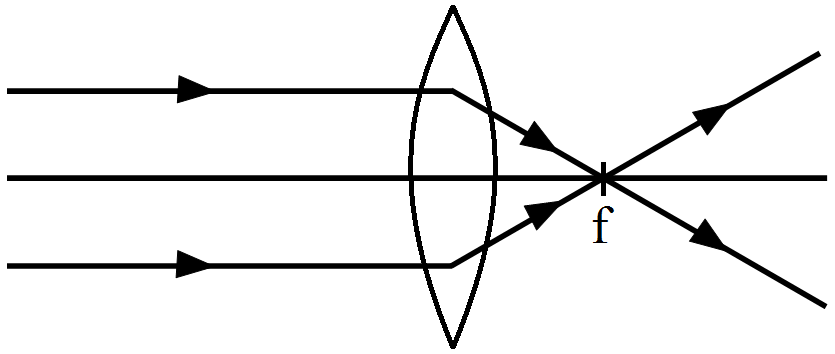
A parallel beam of light is incident on a converging lens parallel to its principal axis. As one moves away from the lens on the other side on its principal axis, the intensity of light:
Answer

  1. First increases then decreases.
Explanation:

The intensity o light is first increases then decreases.

Need a full question paper?

Generate a complete, print-ready paper with questions like this in minutes — across 16+ boards, with answer keys.

Start Generating Free

Similar questions

A man can see the objects upto a distance of one metre from his eyes. For correcting his eye sight so that he can see an object at infinity, he requires a lens whose power is(a) + 0.5 D(b)  + 1.0 D  (c) + 2.0 D(d)  – 1.0 D 
       
In Young's double slit experiment, at a fixed point where $\lambda$ is path difference $=\lambda / 6(\lambda=$ wavelength of the light used), the intensity is I. If $I _0$ is the maximum intensity then $I / I_0$ is equal to :
10 gm of radioactive material of half-life 15 year is kept in store for 20 years. The disintegrated material is(a) 12.5 g(b) 10.5 g(c) 6.03 g(d) 4.03 g
       
The dimensions of electric flux are:
A charge $q$  is placed at the centre of a cube. Then the flux passing through one face of cube will be
One requires energy $\mathrm{E}_{\mathrm{n}}$ to remove a nucleon from a nucleus and an energy $' \ \mathrm{E}_{\mathrm{e}}{ }^{\prime}$ to remove an electron from the orbit of an atom. Then
In producing a pure spectrum, the incident light is passed through a narrow slit placed in the focal plane of an achromatic lens because a narrow slit:
The acceleration of an electron in an electric field of magnitude $50 \mathrm{~V} / \mathrm{cm}$, if $e/m$ value of the electron is $1.76 \times 10^{11} \mathrm{C} / \mathrm{kg},$ is
There is no hole current in conductors, because they have:
In sum and difference method in vibration magnetometer, the time period is more if(a) Similar poles of both magnets are on same sides(b) Opposite poles of both magnets are on same sides(c) Both magnets are perpendicular to each other(d) Nothing can be said