MCQ

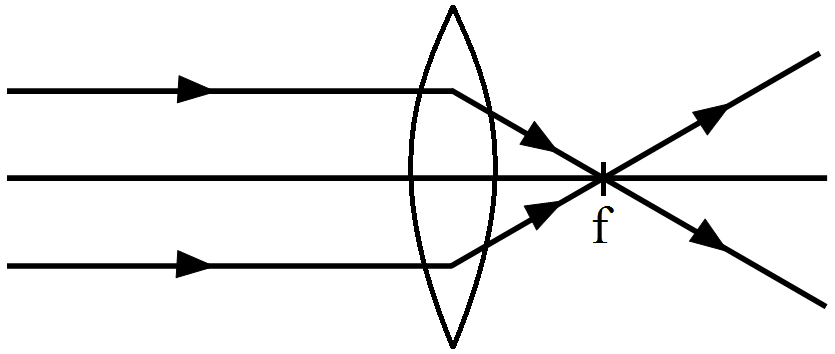
A parallel beam of light is incident on a converging lens parallel to its principal axis. As one moves away from the lens on the other side on its principal axis, the intensity of light:

  • A
    Remains, constant.
  • B
    Continuously increases.
  • C
    Continuously decreases.
  • D
    First increases then decreases.

Answer

  1. First increases then decreases.

Explanation:

The intensity o light is first increases then decreases.

Need a full question paper?

Generate a complete, print-ready paper with questions like this in minutes — across 16+ boards, with answer keys.

Start Generating Free

Similar questions

The speed of light depends:
  1. On elasticity of the medium only.
  2. On inertia of the medium only.
  3. On elasticity as well as inertia.
  4. Neither on elasticity nor on inertia.
Earth’s potential is _______?

The ionisation energy of hydrogen atom is 13.6 eV. Following Bohr's theory, the energy corresponding to a transition between the 3rd and the 4th orbit is

(a) 3.40 eV

(b) 1.51 eV

(c) 0.85 eV

(d) 0.66 eV

The power of two convex lenses A and B are 8 diopters and 4 diopters respectively. If they are to be used as a simple microscope, the magnification of

(a) B will be greater than A  

(b) A will be greater than B 

(c) The information is incomplete 

(d) None of the above 

The electric flux through a certain area of dielectric is 8.76 × 10³t4. The displacement current through the area is 12.9pA at t = 26.1ms . Find the dielectric constant of the material.

A luminous object is placed at a distance of 30 cm from the convex lens of focal length 20 cm. On the other side of the lens, at what distance from the lens a convex mirror of radius of curvature 10 cm be placed in order to have an upright image of the object coincident with it

(a) 12 cm

(b) 30 cm

(c) 50 cm

(d) 60 cm

The velocity of light emitted by a source S observed by an observer O, who is at rest with respect to S is c. If the observer moves towards S with velocity v, the velocity of light as observed will be

(a) c + v  

(b) c - v

(c) c  

(d)  

For a thermocouple the neutral temperature is 270  when its cold junction is at 20. What will be the neutral temperature and the temperature of inversion when the temperature of cold junction is increased to 40

(a) 290, 580

(b) 270, 580

(c) 270, 500

(d) 290 , 540

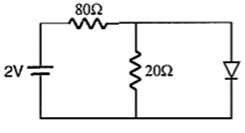
In the circuit shown, the current through the ideal diode is:
Image

A nucleus of an element  emits an a-particle first, a b-particle next and then a gamma photon. The final nucleus formed has an atomic number

(a) 200

(b) 199

(c) 83       

(d) 198