MCQ
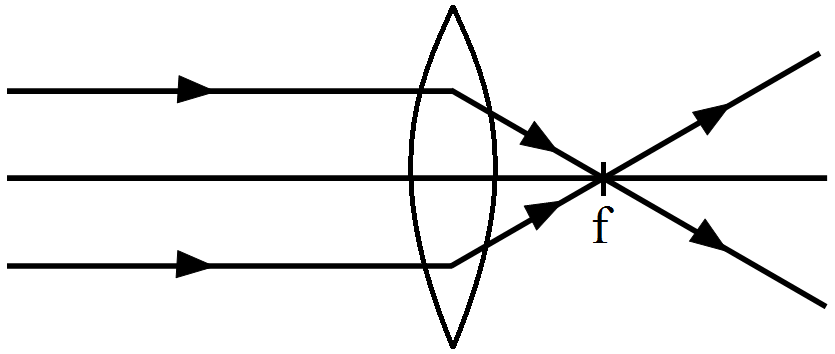
A parallel beam of light is incident on a converging lens parallel to its principal axis. As one moves away from the lens on the other side on its principal axis, the intensity of light:
  • A
    Remains, constant.
  • B
    Continuously increases.
  • C
    Continuously decreases.
  • First increases then decreases.

Answer

Correct option: D.
First increases then decreases.

The intensity o light is first increases then decreases.

Need a full question paper?

Generate a complete, print-ready paper with questions like this in minutes — across 16+ boards, with answer keys.

Start Generating Free

Similar questions

The wavelength of light in two liquids ‘x' and ‘y' is 3500 Å and 7000 Å, then the critical angle of x relative to y will be
A charge $q$ moves in a region where electric field and magnetic field both exist, then force on it is
There is an air filled 1 pF parallel plate capacitor. When the plate separation is doubled and the space is filled with wax, the capacitance increases to 2pF. The dielectric constant of wax is
The minimum deviation produced by a hollow prism filled with a certain liquid is found to be 30°. The light ray is also found to be refracted at angle of 30°. The refractive index of the liquid is
$A$ ray of light is incident normally on one face of $30^o - 60^o - 90^o$ prism of refractive index $5/3$ immersed in water of refractive index $4/3$ as shown in figure.
A microscope has an objective of focal length $1.5\, cm$ and an eye-piece of focal length $2.5\, cm$. If the distance between objective and eye-piece is $25\, cm$ the approximate value of magnification produced for relaxed eye is ?
Two wires of same metal have the same length but their cross-sections are in the ratio $3:1$. They are joined in series. The resistance of the thicker wire is $10\,\Omega $. The total resistance of the combination will be ............. $\Omega$
A mixture of light, consisting of wavelength $590\ nm$ and an unknown wavelength, illuminates Young's double slit and gives rise to two overlapping interference patterns on the screen. The central maximum ofboth lights coincide. Further, it is observed that the third bright fringe of known light coincides with the $4^{th }$ bright fringe of the unknown light. From this data, the wavelength of the unknown light is......$nm$
The radius of curvature of the curved surface of a plano$-$convex lens is $20\ cm$. If the refractive index of the material of the lens be $1.5,$ it will.
The Rutherford $\alpha -$particle experiment shows that most of the $\alpha -$particles pass through almost unscattered while some are scattered through large angles. What information does it give about the structure of the atom?