MCQ
A parallel plate capacitor carries a charge $q$. The distance between the plates is doubled by application of a force. The work done by the force is
  • A
    Zero
  • B
    $\frac{{{q^2}}}{C}$
  • $\frac{{{q^2}}}{{2C}}$
  • D
    $\frac{{{q^2}}}{{4C}}$

Answer

Correct option: C.
$\frac{{{q^2}}}{{2C}}$
c
(c) Work done appears in the form of energy which is given by $\frac{{{q^2}}}{{2C}}$

Need a full question paper?

Generate a complete, print-ready paper with questions like this in minutes — across 16+ boards, with answer keys.
Start Generating Free

Similar questions

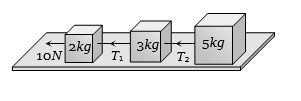
Three blocks of masses $2 \,kg, 3 \,kg$ and $5\, kg$ are connected to each other with light string and are then placed on a frictionless surface as shown in the figure. The system is pulled by a force $F = 10N,$ then tension ${T_1} = $  .......... $N$ 
The length of needle floating on the surface of water is $1.5\,cm$. The force in addition to its weight required to lift the needle from water surface will be...... $N$  (surface tension of water $= 7.5\,N/cm$ )
The dispersive power of the material of lens of focal length $20 cm$ is $0.08.$ The longitudinal chromatic aberration of the lens is......$cm$
Laser beams are used to measure long distances because
If the earth is at one-fourth of its present distance from the sun, the duration of the year will be
Concretemixture is made by mixing cement, stone and sand in a rotating cylindrical drum . If the drum rotates too fast, the ingredients remain stuck to the wall of the drum and proper mixing of ingredients does not take place. The maximum rotational speed of the drum in revolutions per minute (rpm) to ensure proper mixing is close to (Take the radius of the drum to be $1.25\, m$ and its axle to be horizontal)
A wave is given by $y = 3\sin 2\pi \left( {\frac{t}{{0.04}} - \frac{x}{{0.01}}} \right)$, where $y$ is in $cm$. Frequency of wave and maximum acceleration of particle will be
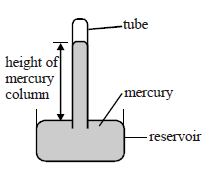
The diagram shows a simple mercury barometer.Which of the following does not cause the height of the mercury column to vary ?
Two $10 \; cm$ long, straight wires, each carrying a current of $5 \; A$ are kept parallel to each other. If each wire experienced a force of $10^{-5} \; N$, then separation between the wires is $\dots \; cm$.
A heating element has a resistance of  $100\,\Omega $ at room temperature. When it is connected to a supply of  $220\,V,$  a steady current of $2\,A$  passes in it and temperature is $500\,^oC$ more than room temperature. What is the temperature coefficient resistance of the heating element?