Question

A parallel plate capacitor, each with plate area A and separation d, is charged to a potential difference V. The battery used to charge it is then disconnected. A dielectric slab of thickness d and dielectric constant K is now placed between the plates. What change, if any, will take place in.

  1.  Charge on the plates.
  2. Electric field intensity between the plates.
  3. Capacitance of the capacitor.

Answer

  1. No change.

As the battery is disconnected.

  1. Decreases OR becomes $\frac{1}{\text{k}}$ times Due to polarisation of the dielectric.
  2. Increases OR becomes k times.

As the electric field, and therefore, the p.d., between the plates decreases.

Need a full question paper?

Generate a complete, print-ready paper with questions like this in minutes — across 16+ boards, with answer keys.

Start Generating Free

Similar questions

  1. Draw a ray diagram depicting the formation of the image by an astronomical telescope in normal adjustment.
  2. You are given the following three lenses. Which two lenses will you use as an eyepiece and as an objective to construct an astronomical telescope? Give reason.
Lenses Power (D) Aperture (cm)
L1 3 8
L2 6 1
L3 10 1
  1. Name the phenomenon on which the working of an optical fibre is based.
  2. What are the necessary conditions for this phenomenon to occur?
  3. Draw a labelled diagram of an optical fibre and show how light propagates through the optical fibre using this phenomenon.
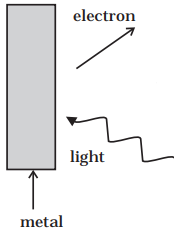
Consider Fig. for photoemission.
How would you reconcile with momentum-conservation? Note light (photons) have momentum in a different direction than the emitted electrons.

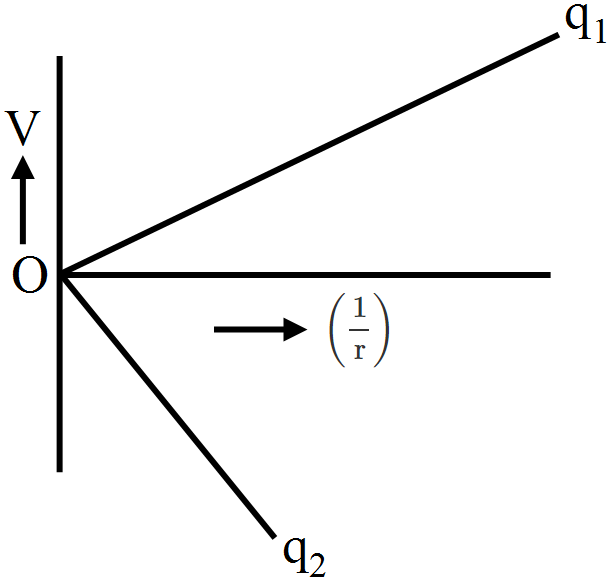
The two graphs are drawn below, show the variations of electrostatic potential (V) $\frac{1}{\text{r}}$ (r being the distance of field point from the point charge) for two point charges q1 and q2.
  1. What are the signs of the two charges?
  2. Which of the two charges has the larger magnitude and why?
​​​​​​​​​​​​​​
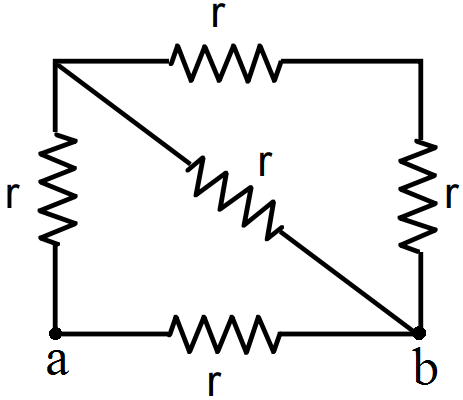
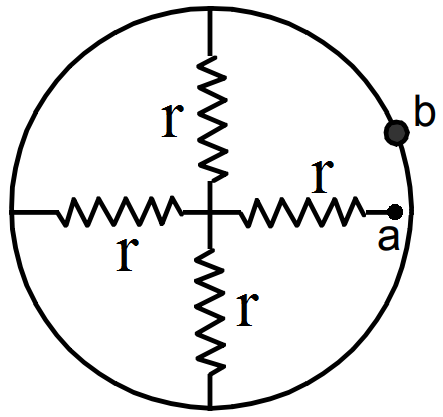
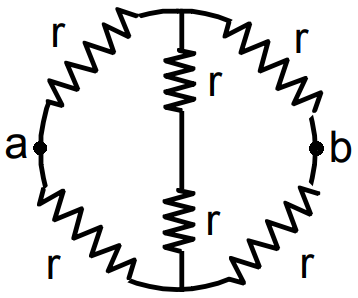
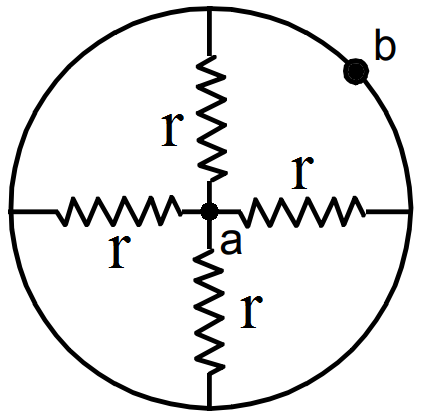
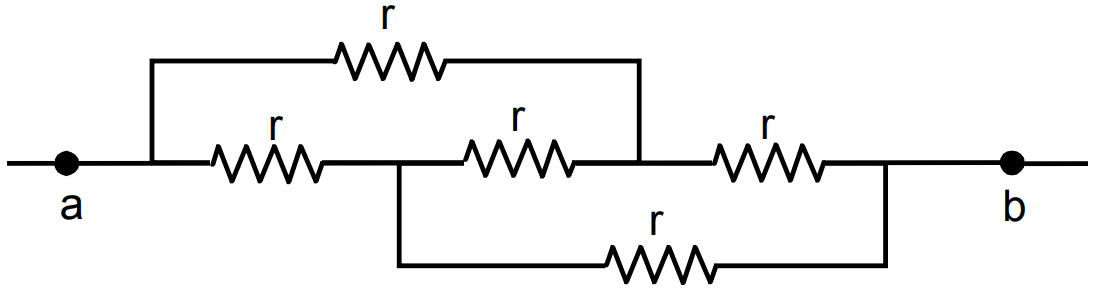
Find the equivalent resistances of the networks shown in the figure. between the points a and b.

  1.  

  1.  

  1.  

  1.  

  1.  

  1. Derive an expression for drift velocity of free electrons.
  2. How does drift velocity of electrons in a metallic conductor vary with increase in temperature? Explain.
An air-cored solenoid with length 30cm, area of cross-section 25cm2 and number of turns 500, carries a current of 2.5A. The current is suddenly switched off in a brief time of 10–3s. How much is the average back emf induced across the ends of the open switch in the circuit? Ignore the variation in magnetic field near the ends of the solenoid.
A particle goes in a circle of radius 2.0cm. A concave mirror of focal length 20cm is placed with its principal axis passing through the centre of the circle and perpendicular to its plane. The distance between the pole of the mirror and the centre of the circle is 30cm. Calculate the radius of the circle formed by the image.
Is it possible for two bodies to be in thermal equilibrium if they are not in contact?
  1. Define the term ‘intensity of radiation’ in terms of photon picture of light.
  2. Two monochromatic beams, one red and the other blue, have the same intensity. In which case (i) The number of photons per unit area per second is larger, (ii) The maximum kinetic energy of the photoelectrons is more? Justify your answer.