Question
A parallel $-$ plate capacitor having plate area $20\ cm^2$ and separation between the plates $1.00\ mm$ is connected to a battery of $12.0V.$ The plates are pulled apart to increase the separation to $2.0\ mm.$
  1. Calculate the charge flown through the circuit during the process.
  2. How much energy is absorbed by the battery during the process?
  3. Calculate the stored energy in the electric field before and after the process.
  4. Using the expression for the force between the plates, find the work done by the person pulling the plates apart.
  5. Show and justify that no heat is produced during this transfer of charge as the separatio
  1. n is increased.

Answer

Area $= a = 20\ cm^2 = 2 \times 10^{-2}m^2 d =$ Separation $= 1\ mm = 10^{-3}m$
$\text{C}_{\text{i}}=\frac{\epsilon_0\times2\times10^{-3}}{10^{-3}}=2\epsilon_0$
$\text{C}_{\text{f}}=\frac{\epsilon_0\times2\times10^{-3}}{2\times10^{-3}}=\epsilon_0$
$\text{q}_{\text{i}}=24\epsilon_0$
$\text{q}_{\text{f}}=12\epsilon_0$
  1. So, $q$ flown out $12\epsilon_0.$ i.e., $q_i - q_f$
So $, q = 12 \times 8.85 \times 10^{-12} = 106.2 \times 10^{-12}C = 1.06 \times 10^{-10}C$
  1. Energy absorbed by battery during the process
$= q \times v = 1.06 \times 10^{-10}C \times 12$
$= 12.7 \times 10^{-10}J$
  1. Before the process
$\text{E}_{\text{i}}=\Big(\frac{1}{2}\Big)\times\text{C}_{\text{i}}\times\text{V}^2$
$=\Big(\frac{1}{2}\Big)\times2\times8.85\times10^{-12}\times144$
$=12.7\times10^{-10}\text{J}$
After the force
$\text{E}_{\text{f}}=\Big(\frac{1}{2}\Big)\times\text{C}_{\text{f}}\times\text{V}^2$
$=\Big(\frac{1}{2}\Big)\times8.85\times10^{-12}\times144$
$=6.35\times10^{-10}\text{J}$
  1. Workdone $=$ Force $\times$ Distance
$=\frac{1}{2}\frac{\text{q}^2}{\epsilon_0\text{A}}=1\times10^{3}$
$=\frac{1}{2}\times\frac{12\times12\times\epsilon_0\times\epsilon_0\times10^{-3}}{\epsilon_0\times2\times10^{-3}}$​​​​​​​
  1. From $(c)$ and $(d)$ we have calculated, the energy loss by the separation of plates is equal to the work done by the man on plate.
Hence no heat is produced in transformer.

Need a full question paper?

Generate a complete, print-ready paper with questions like this in minutes — across 16+ boards, with answer keys.

Start Generating Free

Similar questions

The $\text{K}_\alpha$ and $\text{K}_\beta$ X-rays of molybdenum have wavelengths 0.71A and 0.63A respectively. Find the wavelength of $\text{L}_\alpha$ X-ray of molybdenum.


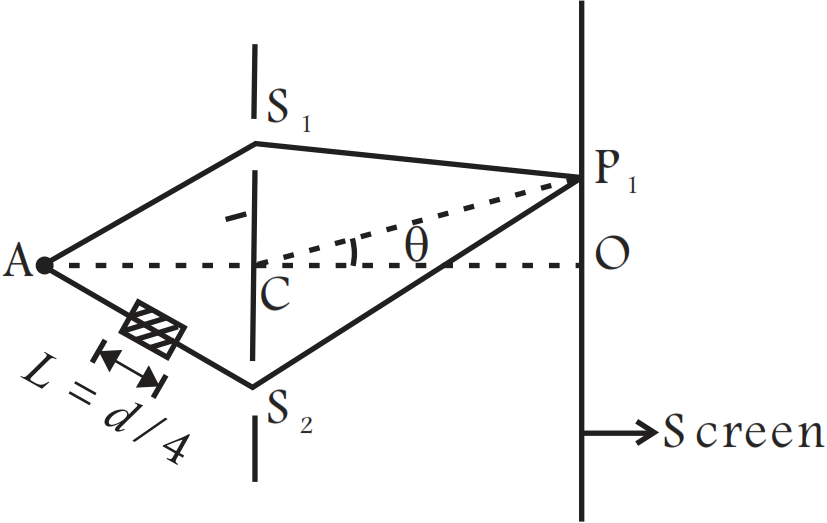
$\ce{AC = CO = D, S_1C = S_2C = d < < D}$
A small transparent slab containing material of $\mu = 1.5$ is placed along $AS_2 ($Fig$)$. What will be the distance from $O$ of the principal maxima and of the first minima on either side of the principal maxima obtained in the absence of the glass slab.
Write the Biot-Savart's law and use it to obtain the expression for the magnetic field at the point on the axis of a current carrying circular loop.
What is dispersion of light? Explain its cause. Deviation of red colour is minimum white that for violet colour is minimum due to dispersion by prism. Explain it. Draw a diagram for dispersion.
  1. Draw a schematic sketch of a cyclotron. Explain clearly the role of crossed electric and magnetic field in accelerating the charge. Hence derive the expression for the kinetic energy acquired by the particles.
  2. An $\alpha –$ particle and a proton are released from the centre of the cyclotron and made to accelerate.
    1. Can both be accelerated at the same cyclotron frequency? Give reason to justify your answer.
    2. When they are accelerated in turn, which of the two will have higher velocity at the exit slit of the dees?
A hollow metallic sphere of radius $20\ cm$ surrounds a concentric metallic sphere of radius $5\ cm.$ The space between the two spheres is filled with a nonmetallic material. The inner and outer spheres are maintained at $50^\circ C$ and $10^\circ C$ respectively and it is found that $100J$ of heat passes from the inner sphere to the outer sphere per second. Find the thermal conductivity of the material between the spheres.
A cube of side b has a charge q at each of its vertices. Determine the potential and electric field due to this charge array at the centre of the cube.
For an $\text{LCR}$ circuit driven at frequency $\omega$, the equation reads $\text{L}\frac{\text{di}}{\text{dt}}+\text{Ri}+\frac{\text{q}}{\text{C}}=\text{v}_\text{i}=\text{v}_\text{m}\sin\omega\text{t}$.
A square loop of side $12\ cm$ with its sides parallel to $X$ and $Y$ axes is moved with a velocity of $8\ cms^{–1}$ in the positive $x-$ direction in an environment containing a magnetic field in the positive $z-$ direction. The field is neither uniform in space nor constant in time. It has a gradient of $10^{–3}T \ cm^{–1}$ along the negative $x-$ direction $($that is it increases by $10^{–3}T \ cm^{–1}$ as one moves in the negative $x-$ direction$),$ and it is decreasing in time at the rate of $10 ^{–3}T s^{–1}$. Determine the direction and magnitude of the induced current in the loop if its resistance is $4.50 m\Omega$ .
$(I) (a)$ A giant refracting telescope at an observatory has an objective lens of focal length $15 m$. If an eyepiece of focal length $1.0 \ cm$ is used, what is angular magnification of the telescope in normal adjustment?
$(b)$ If this telescope is used to view the moon, what is the diameter of the image of the moon formed by the objective lens? The diameter of the moon is $3.48 \times 10^6 m$ and the radius of lunar orbit is $3.8 \times 10^8 m$.