Question
A parallel-plate capacitor having plate area 25cm2 and separation 1.00mm is connected to a battery of 6.0V. Calculate the charge flown through the battery. How much work has been done by the battery during the process?
Answer


$\text{A}=25\text{cm}^2=2.5\times10^{-3}\text{cm}^2$

$\text{d}=1\text{mm}=0.01\text{m}$

$\text{V}=\text{6V},\ \text{Q}=1$

$\text{C}=\frac{\in_0\text{A}}{\text{d}}=\frac{8.854\times10^{-12}\times2.5\times10^{-3}}{0.01}$

$\text{Q}=\text{CV}=\frac{8.854\times10^{-12}\times2.5\times10^{-3}}{0.01}\times6$

$=1.32810\times10^{-10}\text{C}$

$\text{W}=\text{Q}\times\text{V}=1.32810\times10^{-10}\text{C}\times6$

$=8\times10^{-10}\text{J}.$

Need a full question paper?

Generate a complete, print-ready paper with questions like this in minutes — across 16+ boards, with answer keys.
Start Generating Free

Similar questions

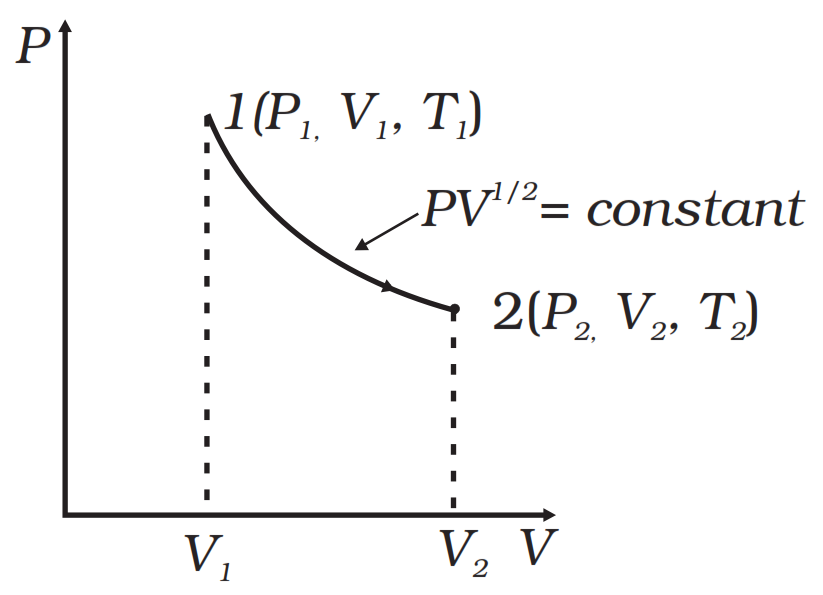
Consider a P-V diagram in which the path followed by one mole of perfect gas in a cylindrical container is shown in Fig.

Given the internal energy for one mole of gas at temperature T is (3/2) RT, find the heat  supplied to the gas when it is taken from state (1) to (2)  with V2 = 2V1.
The time of flight of an object projected at an angle $\theta$ is T. What will be its time of flight, if the object be projected at an angle $(90-\theta)^\circ?$
Explain why
The angle of contact of mercury with glass is obtuse, while that of water with glass is acute.
A nucleus is at rest in the laboratory frame of reference. Show that if it disintegrates into two smaller nuclei the products must move in opposite directions.
One end of a nylon rope, of length 4.5cm and diameter 6mm, is fixed to a free limb. A monkey, weighing 100N, jumps to catch the free end and stays there. Find the elongation of the rope and the corresponding change in the diameter. Given Young's modulus of nylon = 4.8 × 10¹¹N/ m2 and Poisson's ratio of nylon = 0.2.
In an ideal spring the law $\vec{F}=-k \vec{x}$ is followed. Here $k$ is the spring constant. Calculate the work done by the spring in stretching it to a distance $x$ from its equilibrium position by integral method and graphical method
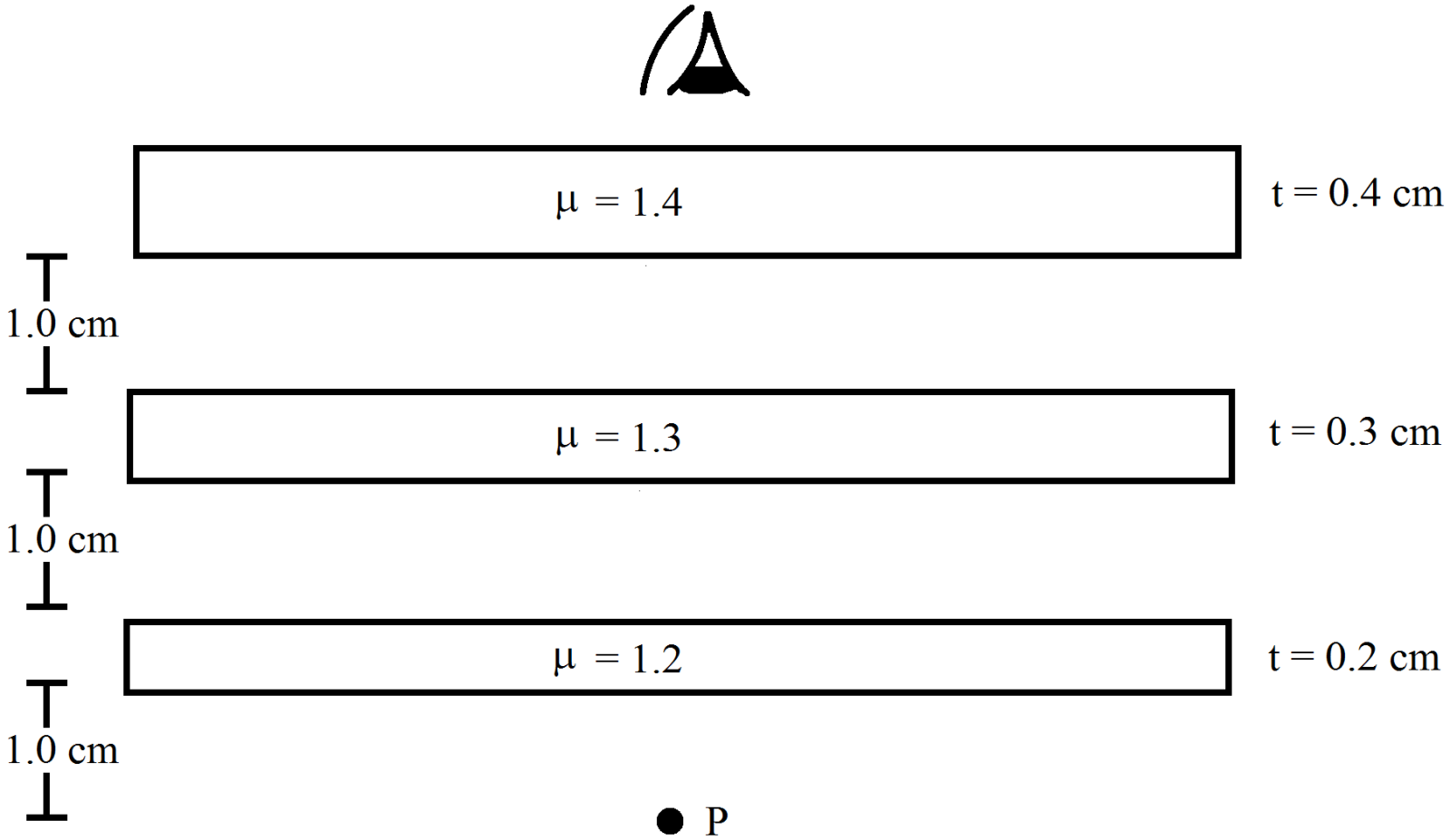
Locate the image of the point P as seen by the eye in the figure.

A spherical black body with a radius of 12cm radiates 450W power at 500K. What would be the power of radiation if radius were to be halved and the temperature doubled.
What are the conditions so that transfer of kinetic energy is maximum during a collision?
It is well known that a raindrop falls under the influence of the downward gravitational force and the opposing resistive force. The latter is known to be proportional to the speed of the drop but is otherwise undetermined. Consider a drop of mass $1.00 g$ falling from a height $1.00 km$. It hits the ground with a speed of $50.0 m s ^{-1}$. (a) What is the work done by the gravitational force? What is the work done by the unknown resistive force?