Question
A parallel-plate capacitor having plate area 400cm2 and separation between the plates 1.0mm is connected to a power supply of 100V. A dielectric slab of thickness 1.0mm and dielectric constant 5.0 is inserted into the gap:
  1. Find the increase in electrostatic energy.
  2. If the power supply is now disconnected and the dielectric slab is taken out, find the further increase in energy.
  3. Why does the energy increase in inserting the slab as well as in taking it out?
Answer

A = 400cm2 = 4 × 10⁻²m2

d = 1cm = 1 × 10⁻³m

V = 160V

t = 0.5 = 5 × 10⁻⁴m

k = 5

$\text{C}=\frac{\in_0\text{A}}{\text{d}-\text{t}+\frac{\text{t}}{\text{k}}}$

$=\frac{8.85\times10^{-12}\times4\times10^{-2}}{10^{-3}-5\times10^{-4}+\frac{5\times10^{-4}}{5}}$

$=\frac{35.4\times10^{-4}}{10^{-3}-0.5}$

Need a full question paper?

Generate a complete, print-ready paper with questions like this in minutes — across 16+ boards, with answer keys.

Start Generating Free

Similar questions

Prove that the distance covered by a uniformly accelerated body in $n ^{\text {th }}$ second
$
s_n=u+\frac{1}{2} a(2 n-1)
$
The electric potential existing m space is V(x, y, z) = A(xy + yz + zx).
  1. Write the dimensional formula of A.
  2. Find the expression for the electric field.
  3. If A is 10 SI units, find the magnitude of the electric field at (1m, 1m, 1m).
A progressive harmonic wave on a string is expressed as follow
$
y(x, t)=7.5 \sin (0.0050 x+12 t+\pi / 4)
$
(a) Find the speed at a point $x=1 cm$ on time $t=1$ sec. Is this speed is equal to the speed of wave propagation?
(b) Find the location of those points of the string whose tranverse displacement and speed are the same as that of the point located at $x=1 cm$ at times $t =2 s, 5 s$ and $11s.$
A rocket is fired ‘vertically’ from the surface of mars with a speed of 2km s-1. If 20% of its initial energy is lost due to martian atmospheric resistance, how far will the rocket go from the surface of mars before returning to it? Mass of mars = 6.4 × 10²³kg; radius of mars = 3395km; G = 6.67 × 10⁻¹¹N m2 kg-2.
State and explain Newton's law of cooling. Calculate the increase in the temperature of water which falls from a height of 100m. Assume that 90% of the energy due to fall is converted into heat and is retained by water. J = 4.2J/ Cal-1.
A converging lens of focal length 15cm and a converging mirror of focal length 10cm are placed 50cm apart with common principal axis. A point source is placed in between the lens and the mirror at a distance of 40cm from the lens. Find the locations of the two images formed.
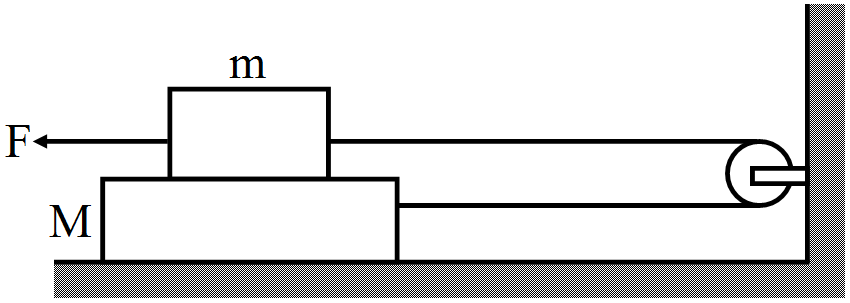
The friction coefficient between the two blocks shown in figure is $\mu$ but the floor is smooth.
  1. What maximum horizontal force F can be applied without disturbing the equilibrium of the system?
  2. Suppose the horizontal force applied is double of that found in part (a). Find the accelerations of the two masses.
​​​​​​​
An elastic spring of force constant K is compressed by an amount x. Show that its potential energy is $\frac{1}{2}\text{Kr}^2.$
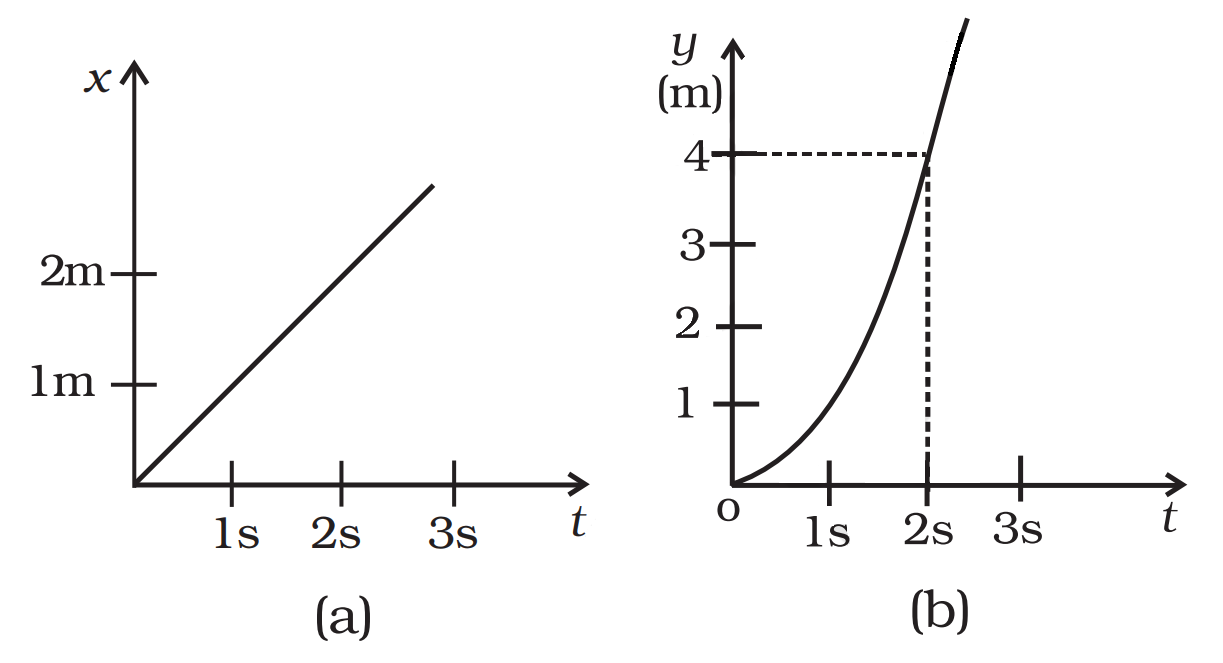
shows (x, t), (y, t) diagram of a particle moving in 2-dimensions.

If the particle has a mass of 500g, find the force (direction and magnitude) acting on the particle.

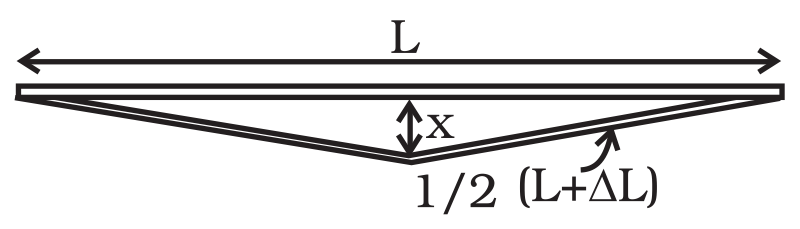
A rail track made of steel having length 10m is clamped on a raillway line at its two ends. On a summer day due to rise in temperature by 20°C , it is deformed as shown in figure. Find x(displacement of the centre) if $\alpha_\text{steel}=1.2\times10^{-5}/{^\circ\text{C}}.$