Question
A parallel-plate capacitor having plate area 400cm2 and separation between the plates 1.0mm is connected to a power supply of 100V. A dielectric slab of thickness 1.0mm and dielectric constant 5.0 is inserted into the gap:
  1. Find the increase in electrostatic energy.
  2. If the power supply is now disconnected and the dielectric slab is taken out, find the further increase in energy.
  3. Why does the energy increase in inserting the slab as well as in taking it out?
Answer

A = 400cm2 = 4 × 10⁻²m2
d = 1cm = 1 × 10⁻³m
V = 160V
t = 0.5 = 5 × 10⁻⁴m
k = 5
$\text{C}=\frac{\in_0\text{A}}{\text{d}-\text{t}+\frac{\text{t}}{\text{k}}}$
$=\frac{8.85\times10^{-12}\times4\times10^{-2}}{10^{-3}-5\times10^{-4}+\frac{5\times10^{-4}}{5}}$
$=\frac{35.4\times10^{-4}}{10^{-3}-0.5}$

Need a full question paper?

Generate a complete, print-ready paper with questions like this in minutes — across 16+ boards, with answer keys.

Start Generating Free

Similar questions

Two glass bulbs of equal volume are connected by a narrow tube and are filled with a gas at 0°C at a pressure of 76cm of mercury. One of the bulbs is then placed in melting ice and the other is placed in a water bath maintained at 62°C. What is the new value of the pressure inside the bulbs? The volume of the connecting tube is negligible.
Figure shows a square loop ABCD with edgelength a. The resistance of the wire ABC is r and that of ADC is 2r. Find the magnetic field B at the centre of the loop assuming uniform wires.

The short-wavelength limit shifts by 26pm when the operating voltage in an X-ray tube is increased to 1.5 times the original value. What was the original value of the operating voltage?
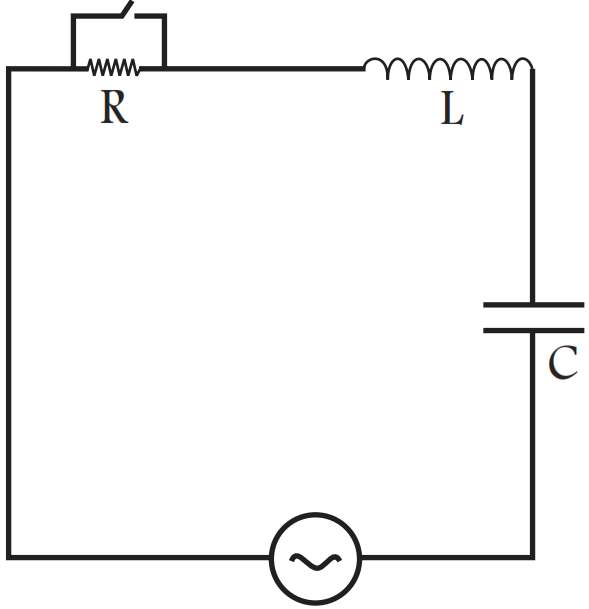
In the LCR circuit shown in Fig, the ac driving voltage is $\text{v}=\text{v}_\text{m}\sin\omega\text{t}$.

  1. Write down the equation of motion for q(t).
  2. At t = t0, the voltage source stops and R is short circuited. Now write down how much energy is stored in each of L and C.
  3. Describe subsequent motion of charges

Explain the uses of Polaroid.
What are coherent sources of light? Why are coherent sources required to produce interference of light? Give an example of interference in everyday life.
Two metre scales, one of steel and the other of aluminium, agree at 20°C. Calculate the ratio aluminium-centimetre/ steel-centimetre at:
  1. 0°C,
  2. 40°C
  3. 100C. $\alpha$ for steel = 1.1 × 10-5 °C-1 and for aluminium= 2.3 × 10⁻⁵ °C-1.
a. Draw graphs showing the variations of inductive reactance and capacitive reactance with the frequency of the applied ac source.
b. Draw the phasor diagram for a series RC circuit connected to an ac source.
c. An alternating voltage of 220 V is applied across a device X, a current of 0.25 A flows, which lag behind the applied voltage in phase by $\frac{\pi}{2}$ radian. If the same voltage is applied across another device Y, the same current flows but now it is in phase with the applied voltage.
i. Name the devices X and Y.
ii. Calculate the current flowing in the circuit when the same voltage is applied across the series combination of X and Y.
Repeat the previous problem if the particle C is displaced through a distance x along the line AB.
Consider the de Broglie wavelength of an electron and a proton. Which wavelength is smaller if the two particles have.
  1. The same speed.
  2. The same momentum.
  3. The same energy?.