- A$6 / 5$
- B$5 / 3$
- C$7 / 5$
- ✓$7 / 3$
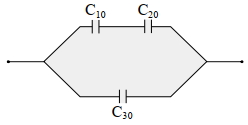
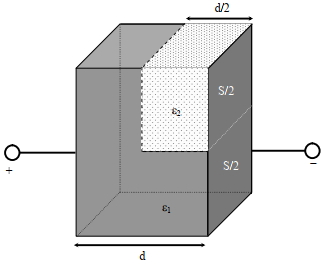
$C _{20}=\frac{2 \varepsilon_0 S }{ d }, C _{30}=\frac{\varepsilon_0 S }{ d }$
$\frac{1}{ C _{10}^{\prime}}=\frac{1}{ C _{10}}+\frac{1}{ C _{10}}=\frac{ d }{2 \varepsilon_0 S }\left[1+\frac{1}{2}\right]$
$\Rightarrow C _{10}^{\prime}=\frac{4 \varepsilon_0 S }{3 d }$
$C _2= C _{30}+ C _{10}^{\prime}=\frac{7 \varepsilon_0 S }{3 d }$
$\frac{ C _2}{ C _1}=\frac{7}{3}$
Generate a complete, print-ready paper with questions like this in minutes — across 16+ boards, with answer keys.


$(A)$ Radioactivity is a random and spontaneous process and is dependent on physical and chemical conditions.
$(B)$ The number of un-decayed nuclei in the radioactive sample decays exponentially with time.
$(C)$ Slope of the graph of $\log _{e}$ (no. of undecayed nuclei) $Vs$. time represents the reciprocal of mean life time $(\tau)$.
$(D)$ Product of decay constant ( $\lambda$ ) and half-life time $\left(T_{1 / 2}\right)$ is not constant.
Choose the most appropriate answer from the options given below