Question
A parallel plate capacitor is being charged by a time varying current. Explain briefly how Ampere's circuital law is generalized to incorporate the effect due to the displacement current.
Answer


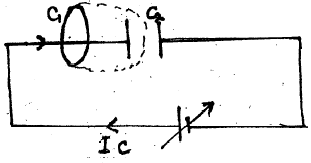
According to Ampere's circuital law, $\oint\overline{\text{B}}.\overline{\text{dl}} = \mu_{o}\text{I}_{en}$
For $C_{1 }\oint\overline{\text{B}}.\overline{\text{dl}} = \mu_{o}\text{I}_{en}$
For $C_{2 }\oint\overline{\text{B}}.\overline{\text{dl}} = 0 $
There is an inconsistency in Ampere's circuital law.To explain this displacement current was incorporated.
Using Ampere's law, we find different values of $B$ for the two loops.
Hence displacement current was introduced.

Need a full question paper?

Generate a complete, print-ready paper with questions like this in minutes — across 16+ boards, with answer keys.

Start Generating Free

Similar questions

Obtain expression of self inductance of a solenoid having length $l$ and cross-section of area A .
A closed organ pipe can vibrate at a minimum frequency of 500Hz. Find the length of the tube. Speed of sound in air = 340m/s.
The dielectric strength of air is $3.0 \times 10^6V/m.$ A parallel$-$plate air$-$capacitor has area $20\ cm^2$ and plate separation $0.10\ mm.$ Find the maximum rms voltage of an $AC$ source that can be safely connected to this capacitor.
Write down the difference between series and parallel connection of capacitors
Describe Young's experiment performed to obtain coherent sources (More popularly known as Young's Double Slit Experiment) with proper figure.
A boy is seated in a revolving chair revolving at an angular speed of $120$ revolutions per minute. Two heavy balls form part of the revolving system and the boy can pull the balls closer to himself or may push them apart. If by pulling the balls closer, the boy decreases the moment of inertia of the system from $6\ kg-m^2$ to $2\ kg-m^2,$ what will be the new angular speed?
Resistance of a galvanometer is $30 \Omega$. A current of 2 mA gives full scale deflection in it. Calculate the necessary resistance required to make it an ammeter of range $(0-0.3 A)$.
Find the maximum angular speed of the electron of a hydrogen atom in a stationary orbit.
Obtain Primary results from law of refraction.
The force on a charged particle due to electric and magnetic fields is given by $\overrightarrow{\text{F}}=\text{q}\overrightarrow{\text{E}}+\text{q}\overrightarrow{\text{v}}\times\overrightarrow{\text{B}}.$ Suppose $\overrightarrow{\text{E}}$ is along the X-axis and $\overrightarrow{\text{B}}$ along the Y-axis. In what direction and with what minimum speed v should a positively charged particle be sent so that the net force on it is zero?