Question
A parallel plate capacitor is being charged by a time varying current. Explain briefly how Ampere's circuital law is generalized to incorporate the effect due to the displacement current.
Answer


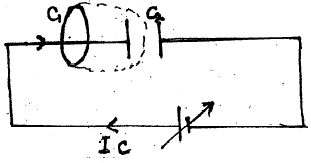
According to Ampere's circuital law, $\oint\overline{\text{B}}.\overline{\text{dl}} = \mu_{o}\text{I}_{en}$
For $C_1 \oint\overline{\text{B}}.\overline{\text{dl}} = \mu_{o}\text{I}_{en}$
For $C_2 \oint\overline{\text{B}}.\overline{\text{dl}} = 0 $
There is an inconsistency in Ampere's circuital law.To explain this displacement current was incorporated.
Using Ampere's law, we find different values of B for the two loops.
Hence displacement current was introduced.

Need a full question paper?

Generate a complete, print-ready paper with questions like this in minutes — across 16+ boards, with answer keys.

Start Generating Free

Similar questions

Compare the direction of the magnetic field inside a solenoid with that of the field there if the solenoid is replaced by its equivalent combination of north pole and south pole.
Show that there can be no net charge in a region m which the electric field is uniform at all points.
Find the maximum angle of refraction when a light ray is refracted from glass $(\mu=1.50)$ to air.
Explain resonance for $\text{L-C-R}$ series $\text{AC}$ circuit. Obtain the equation of resonance frequency and explain resonance curve.
Give a physical explanation of the fact that the potential energy of a positive charge coupled is positive.
A proton and a deuteron are accelerated through the same accelerating potential. Which one of the two has,
  1. greater value of de-Broglie wavelength associated with it, and
  2. less momentum?
Give reasons to justify your answer.
A parallel plate capacitor made of circular plates each of radius R = 6.0 cm has a capacitance C = 100 pF. The capacitor is connected to a 230 V ac supply with a (angular) frequency of 300 rad $S^{-1}$.
  1. What is the rms value of the conduction current?
  2. Is the conduction current equal to the displacement current?
  3. Determine the amplitude of B at a point 3.0 cm from the axis between the plates.
The gravitational field in a region is given by $\overrightarrow{\text{E}}=(5\text{N/kg})\overrightarrow{\text{i}}+(12\text{N/kg})\overrightarrow{\text{j}}.$
  1. Find the magnitude of the gravitational force acting on a particle of mass 2kg placed at the origin.
  2. Find the potential at the points (12m, 0) and (0, 5m) if the potential at the origin is taken to be zero.
  3. Find the change in gravitational potential energy if a particle of mass 2kg is taken from the origin to the point (12m, 5m).
  4. Find the change in potential energy if the particle is taken from (12m, 0) to (0, 5m).
The earth revolves round the sun because the sun attracts the earth. The sun also attracts the moon and this force is 'about twice as large as the attraction of the earth on the moon. Why does the moon not revolve round the sun? Or does it?
  1. The peak voltage of an ac supply is 300V. What is the rms voltage?
  2. The rms value of current in an ac circuit is 10A. What is the peak current?