Question
A parallel plate capacitor is charged by a battery. After sometime the battery is disconnected and a dielectric slab with its thickness equal to the plate separation is inserted between the plates. How will (i) the capacitance of the capacitor, (ii) potential difference between the plates and (iii) the energy stored in the capacitor be affected?
Justify your answer in each case.

Answer

  1. Capacltance $\text{C} = \frac{\text{K}\varepsilon_{0}\text{A}}{\text{d}},$ Hence capacitance Increases K times.
  2. Potential difference $\text{V} = \frac{\text{V}_{o}}{\text{K}},$Hence potential difference decreases by a factor K.
  3. Energy stored E $ =\frac{1}{2}\text{CV}^{2},$ As capacitance becomes K times & potential difference becomes 1/K times therefore energy stored becomes 1/K times.

Alternate Answer

Energy stored = Q2/2C. As capacitance increases by a factor K, the energy stored will decrease by the same factor.

Need a full question paper?

Generate a complete, print-ready paper with questions like this in minutes — across 16+ boards, with answer keys.

Start Generating Free

Similar questions

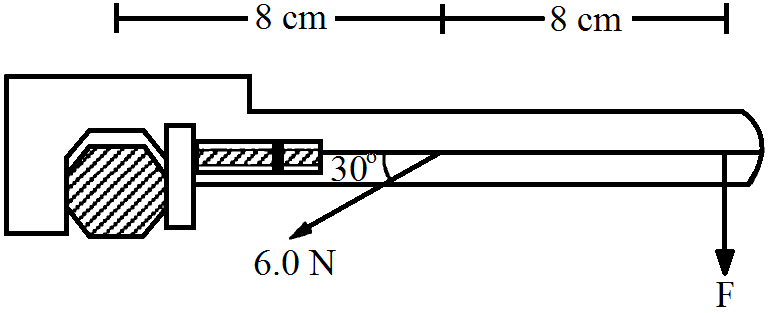
When a force of 6.0N is exerted at 30° to a wrench at a distance of 8cm from the nut, it is just able to loosen the nut. What force F would be sufficient to loosen it if it acts perpendicularly to the wrench at 16cm from the nut?

Derive the equation of drift velocity by explaining the drift motion of electrons and the drift velocity of electrons in a conductor.
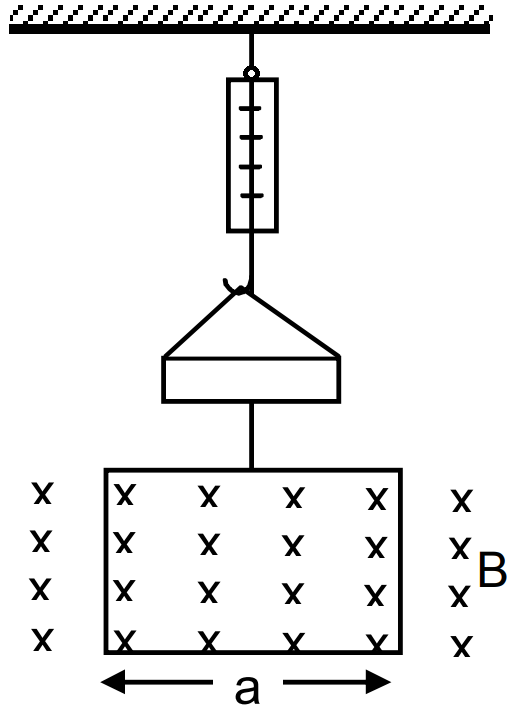
A rectangular wire loop of width a is suspended from the insulated pan of a spring balance, as shown in A current i exists in the anti-clockwise direction in the loop. A magnetic field Bexists in the lower region. Find the change in the tension of the spring if the current in the loop is reversed.

The relative luminosity of wavelength 600nm is 0.6. Find the radiant flux of 600nm needed to produce the same brightness sensation as produced by 120W of radiant flux at 555nm.
If $\vec{\text{A}},\vec{\text{B}},\vec{\text{C}}$ are mutually perpendicular, show that $\vec{\text{C}}\times(\vec{\text{A}}\times\vec{\text{B}})=0.$ Is the converse true?
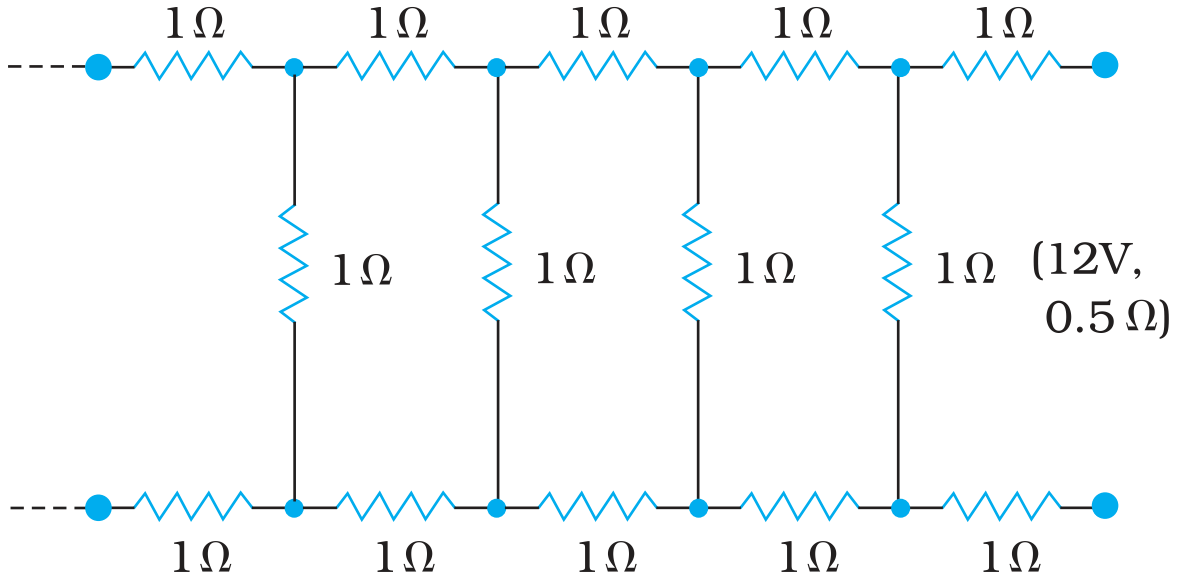
Determine the current drawn from a 12 V supply with internal resistance $0.5\ \Omega$ by the infinite network shown in Fig. Each resistor has $1\ \Omega$ resistance.

A short magnet is moved along the axis of a conducting loop. Show that the loop repels the magnet if the magnet is approaching the loop and attracts the magnet if it is going away from the loop.
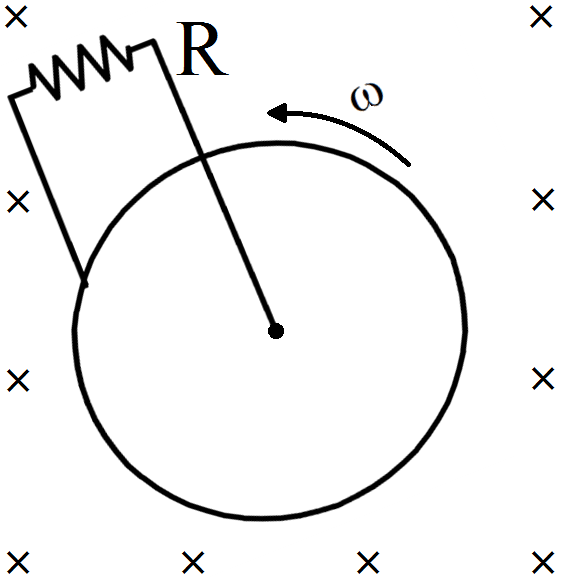
Figure shows a conducting disc rotating about its axis in a perpendicular magnetic field B. A resistor of resistance R is connected between the centre and the rim. Calculate the current in the resistor. Does it enter the disc or leave it at the centre? The radius of the disc is 5.0cm, angular speed $\omega=10 \ \text{rad/s}, \ \text{B}=0.40\text{T}$ and $\text{R}=10\Omega.$

Find the acceleration of a particle placed on the surface of the earth at the equator due to earth's rotation. The diameter of earth = 12800km and it takes 24 hours for the earth to complete one revolution about its axis.
For a CE-transistor amplifier, the audio signal voltage across the collected resistance of 2k Ω is 2 V. Suppose the current amplification factor of the transistor is 100, find the input signal voltage and base current, if the base resistance is 1k Ω.