Question
A parallel plate capacitor is connected to a battery. The quantities charge, voltage, electric field and energy associated with the capacitor are given by $Q_0, V_0, E_0$ and $U_0$ respectively. A dielectric slab is introduced between plates of capacitor but battery is still in connection. The corresponding quantities now given by $Q, V, E$ and $U$ related to previous ones are
Answer

As the battery till in connection so potential will remained unchanged. i,e $V=V_{0}$

$E_{0}=\frac{V_{0}}{d}$ and $E=\frac{V}{d}=\frac{V_{0}}{d} \Rightarrow E=E_{0}$ where $d=$ separation of plates.

Let initial capacitance $=C_{0}$

When dielectric slab with dielectric constant $\mathrm{K}$ is inserted, the capacitance becomes $C=K C_{0}$

Thus, $Q_{0}=C_{0} V_{0}$ and $Q=C V=K C_{0} V_{0}=K Q_{0} \Rightarrow Q>Q_{0}$ as $(K>1)$

$\mathrm{Also}, U_{0}=(1 / 2) C_{0} V_{0}^{2}$ and $U=(1 / 2) C V^{2}=(1 / 2) K C_{0} \cdot V_{0}=K U_{0}$

Hence, $U>U_{0}$

Need a full question paper?

Generate a complete, print-ready paper with questions like this in minutes — across 16+ boards, with answer keys.

Start Generating Free

Similar questions

A balloon has mass of $10\,g$ in air. The air escapes from the balloon at a uniform rate with velocity $4.5\,cm / s$. If the balloon shrinks in $5\,s$ completely. Then, the average force acting on that balloon will be (in dyne).
The amount of work done in forming a soap film of size $10\,cm \times 10\,cm$ is (Surface tension $T = 3 \times {10^{ - 2}}\,N/m$)
The radii of two planets $A$ and $B$ are $R$ and $4 R$ and their densities are $\rho$ and $\rho / 3$ respectively. The ratio of acceleration due to gravity at their surfaces $\left(g_A: g_B\right)$ will be
Two objects are thrown up at angles of $45^{\circ}$ and $60^{\circ}$ respectively, with the horizontal. If both objects attain same vertical height, then the ratio of magnitude of velocities with which these are projected is .........
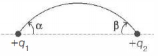
An electrostatic field line leaves at an angle $\alpha$ from point charge $q_{1}$ and connects with point charge $-q_{2}$ at an angle $\beta\left(q_{1}\right.$ and $q_{2}$ are positive) see figure below. If $q_{2}=\frac{3}{2} q_{1}$ and $\alpha=30^{\circ}$, then
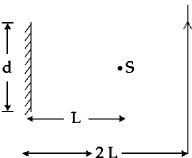
A point source of light, $S$ is placed at a distance $L$ in front of the centre of plane mirror of width $d$ which is hanging vertically on a wall. A man walks in front of the mirror along a line parallel to the mirror, at a distance $2\, L$ as shown below. The distance over which the man can see the image of the light source in the mirror:
In the following nuclear rection, $D \stackrel{\alpha}{\longrightarrow} D _{1} \stackrel{\beta-}{\longrightarrow} D _{2} \stackrel{\alpha}{\longrightarrow} D _{3} \stackrel{\gamma}{\longrightarrow} D _{4}$ Mass number of $D$ is $182$ and atomic number is $74$ . Mass number and atomic number of $D _{4}$ respectively will be
Four spheres of diameter $2 a$ and mass $M$ are placed with their centres on the four corners of a square of side $b$. Then moment of inertia of the system about an axis about one of the sides of the square is ..........
Fundamental frequency of an open pipe of length $0.5 m$ is equal to the frequency of the first overtone of a closed pipe of length $l$. The value of $l_c$ is $(m)$
The acceleration of a particle which moves along the positive $x-$axis varies with its position as shown. If the velocity of the particle is $0.8 m/s$ at $x = 0$ , the velocity of the particle at $x = 1.4$ is(in $m/s$)