Question
A parallel plate capacitor with air between the plates has a capacitance of 8 pF. The separation between the plates is now reduced by half and the space between them is filled with a medium of dielectric constant 5. Calculate the value 
of capacitance of the capacitor in the second case.
Answer

$\text{c} =\frac{\text{A}\varepsilon_{\circ}\varepsilon_{r}}{\text{d}}$ or $\frac{\text{k}\varepsilon_{\circ}\text{A}}{\text{d}}$

$\text{c} = 5\times\frac{\varepsilon_{\circ}\text{A}}{\text{d}/2}$

$\text{c} = 10 \bigg(\frac{\text{A}\varepsilon_{\circ}}{\text{d}}\bigg) = 10 \times8 = 80\text{pf}$.

Need a full question paper?

Generate a complete, print-ready paper with questions like this in minutes — across 16+ boards, with answer keys.

Start Generating Free

Similar questions

In Young’s double-slit experiment using monochromatic light of wavelength λ, the intensities of two sources is I. What is the intensity of light at a point where path difference between wave front is $\lambda / 4$ ?
What is the work function of metal? It depends on which factors?
A tightly-wound, long solenoid has n turns per unit length, a radius r and carries a current i. A particle having charge q and mass m is projected from a point on the axis in a direction perpendicular to the axis. What can be the maximum speed for which the particle does not strike the solenoid ?
A convex lens of diameter 8.0cm is used to focus a parallel beam of light of wavelength 620nm. If the light be focused at a distance of 20cm from the lens, what would be the radius of the central bright spot formed?
Find the maximum angle of refraction when a light ray is refracted from glass $(\mu=1.50)$ to air.
  1. The bluish colour predominates in clear sky.
  2. Violet colour is seen at the bottom of the spectrum when white light is dispersed by a prism.

State reasons to explain these observations.

Show mathematically how Bohr's postulate of quantization of orbital angular momentum in hydrogen atom is explained by de-Broglie's hypothesis.
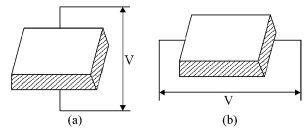
In a given figure, a rectangular object is shown. Its length is I, breadth is 0.5 I and thickness 0.25 I . To measure its resistance, potential difference $V$ is applied in two ways [figure (a) and (b)]. In which arrangement, the resistance of the substance will be more?
Image
Show that the equipotential surfaces are closed together in the regions of strong field and far apart in the regions of weak field. Draw equipotential surfaces for an electric dipole.
Let $\vec{\text{A}}=3\vec{\text{i}}+4\vec{\text{j}}.$ Write four vector $\overrightarrow{\text{B}}$ such that $\overrightarrow{\text{A}}\neq\overrightarrow{\text{B}}$ but A = B.