Question
A parallel-plate capacitor with the plate area 100cm2 and the separation between the plates 1.0cm is connected across a battery of emf 24 volts. Find the force of attraction between the plates.

Answer

A = 100cm2 = 10-2m2

d = 1cm = 10-2m

V = 24V0

$\therefore$ The capacitance $\text{C}=\frac{\in_0\text{A}}{\text{d}}=\frac{8.85\times10^{-12}\times10^{-2}}{10^{-2}}=8.85\times10^{-12}$

$\therefore$ The energy stored $\text{C}_1=\Big(\frac{1}{2}\Big)\text{CV}^2$

$=\Big(\frac{1}{2}\Big)\times10^{-12}\times(24)^2$

$=2548.8\times10^{-12}$

$\therefore$ The forced attraction between the plates $=\frac{\text{C}_1}{\text{d}}=\frac{2548.8\times10^{-12}}{10^{-2}}=2.54\times10^{-7}\text{N.}$

Need a full question paper?

Generate a complete, print-ready paper with questions like this in minutes — across 16+ boards, with answer keys.
Start Generating Free

Similar questions

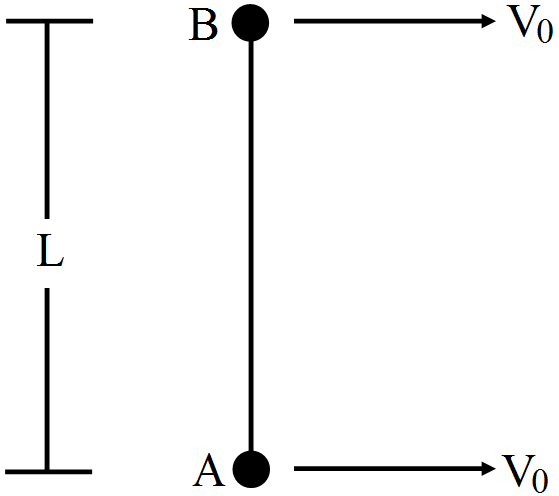
Two small balls A and B, each of mass m, are joined rigidly to the ends of a light rod of lengh L (figure). The system translates on a frictionless horizontal surface with a velocity vo in a direction perpendicular to the rod. A particle P of mass m kept at rest on the surface sticks to the ball A as the ball collides with it. Find:
  1. The linear speeds of the balls A and B after the collision.
  2. The velocity of the centre of mass C of the system A + B + P.
  3. The angular speed of the system about C after the collision.

[Hint: The light rod will exert a force on the ball B only along its length.]
A rocket is fired vertically with a speed of 5km s-1 from the earth’s surface. How far from the earth does the rocket go before returning to the earth? Mass of the earth = 6.0 × 1024kg; mean radius of the earth = 6.4 × 10⁶m; G = 6.67 × 10⁻¹¹Nmkg-2.
Consider that an ideal gas (n moles) is expanding in a process given by P = f( V ), which passes through a point (V0, P0 ). Show that the gas is absorbing heat at (P0, V0 ) if the slope of the curve P = f(V ) is larger than the slope of the adiabat passing through (P0, V0 ).
Two identical steel cubes (masses 50g, side 1cm) collide head-on face to face with a speed of 10cm/ s each. Find the maximum compression of each. Young’s modulus for steel = Y = 2 × 10¹¹ N/ m2.
Draw a graph to show the variation of P.E., K.E. and total energy of a simple harmonic oscillator with displacement.
0.32g of oxygen is kept in a rigid container and is heated. Find the amount of heat needed to raise the temperature from 25°C to 35°C. The molar heat capacity of oxygen at constant volume is 20J mole-1K-1.
Explain the international system of units. Explain its characteristics.
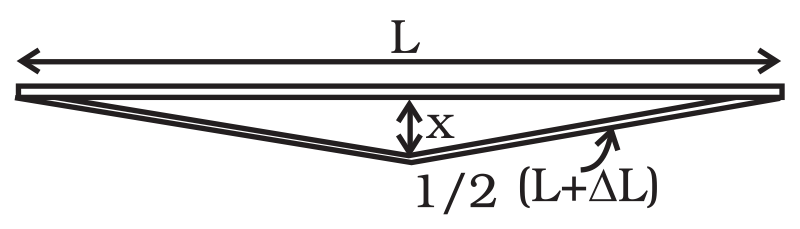
A rail track made of steel having length 10m is clamped on a raillway line at its two ends. On a summer day due to rise in temperature by 20°C , it is deformed as shown in figure. Find x(displacement of the centre) if $\alpha_\text{steel}=1.2\times10^{-5}/{^\circ\text{C}}.$

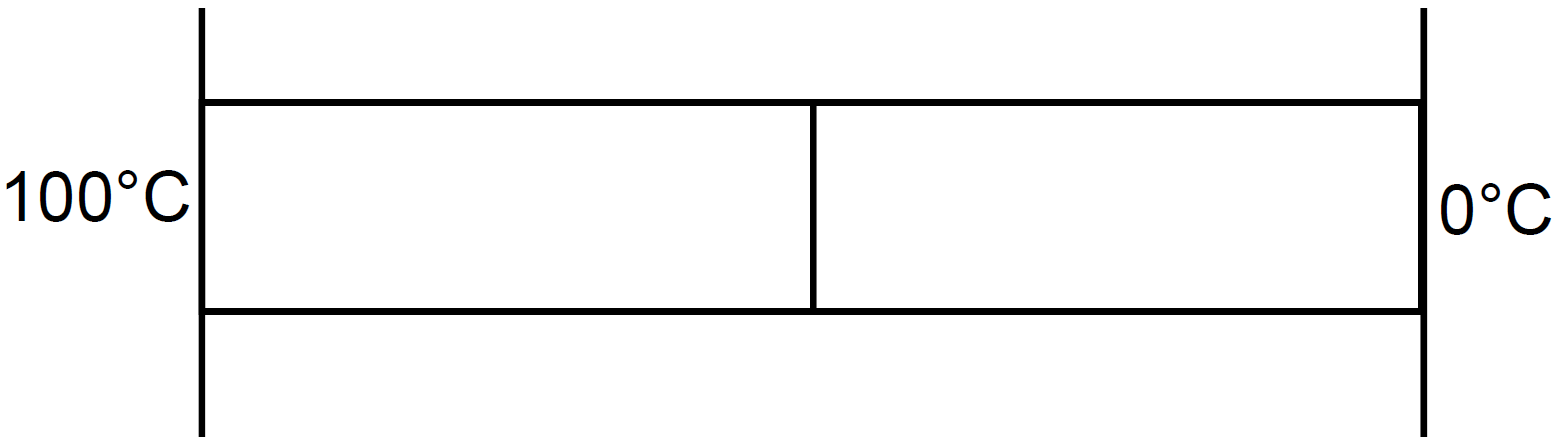
The two rods shown in figure, have identical geometrical dimensions. They are in contact with two heat baths at temperatures 100°C and 0°C. The temperature of the junction is 70°C. Find the temperature of the junction if the rods are interchanged.

It is 260km from Patna to Ranchi by air and 320km by road. An aeroplane takes 30 minutes to go from Patna to Ranchi whereas a delux bus takes 8 hours.
  1. Find the average speed of the plane.
  2. Find the average speed of the bus.
  3. Find the average velocity of the plane.
  4. Find the average velocity of the bus.