MCQ
A paramagnetic sample shows a net magnetization of $8\ Am^{-1}$ when placed in an external magnetic field of $0.6\ T$ at a temperature of $4\ K$ . When the same sample is placed in an external magnetic field of $0.2\ T$ at a temperature of $16\ K$ , the magnetization will be
  • A
    $\frac{{32}}{3}\,A{m^{-1 }}$
  • $\frac{2}{3}\,A{m^{-1}}$
  • C
    $6\,A{m^{-1}}$
  • D
    $2.4\,A{m^{-1}}$

Answer

Correct option: B.
$\frac{2}{3}\,A{m^{-1}}$
b
$\mathrm{I}=\chi \mathrm{H}$ and $\chi=\frac{\mathrm{C}}{\mathrm{T}}$ (according to curie law)

Magnetization $(I)$

$\propto \frac{\text { Magnetic Induction (B) }}{\text { Absolute temperature (T) }}$

$\frac{\mathrm{I}_{2}}{\mathrm{I}_{1}}=\frac{\mathrm{B}_{2} \mathrm{T}_{1}}{\mathrm{B}_{1} \mathrm{T}_{2}}$

Need a full question paper?

Generate a complete, print-ready paper with questions like this in minutes — across 16+ boards, with answer keys.

Start Generating Free

Similar questions

Two mirrors, labeled $LM$ for left mirror and $RM$ for right mirror in the adjacent figure, are parallel to each other and $3.0\, m$ apart. $A$ person standing $1.0\, m$ from the right mirror $(RM)$ looks into this mirror and sees a series of images. How far from the person is the second closest image seen in the right mirror $(RM)$?......$m$
The $Q$-value of a nuclear reaction and kinetic energy of the projectile particle, $K _{ p }$ are related as
Current $I$ in the network shown in figure is .......... $A$
A spherical ball contracts in volume by $0.02 \%$, when subjected to a normal uniform pressure of $50$ atmosphere. The Bulk modulus of its material is ............. $Nm ^{-2}$
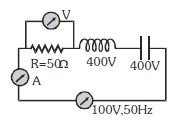
In given $LCR$ circuit, the voltage across the terminals of a resistance and current will be
A spring block system in horizontal oscillation has a time-period $T$. Now the spring is cut into four equal parts and the block is re-connected with one of the parts. The new time period of vertical oscillation will be
The magnetic flux through a circuit of resistance $R$ changes by an amount $\Delta \phi $ in time $\Delta t$, Then the total quantity of electric charge $Q$, which passing during this time through any point of the circuit is given by
Students $I$, $II$ and $III$ perform an experiment for measuring the acceleration due to gravity $(g)$ using a simple pendulum.

They use different lengths of the pendulum and /or record time for different number of oscillations. The observations are shown in the table.

Least count for length $=0.1 \mathrm{~cm}$

Least count for time $=0.1 \mathrm{~s}$

Student Length of the pendulum $(cm)$ Number of oscillations $(n)$ Total time for $(n)$ oscillations $(s)$ Time period $(s)$
$I.$ $64.0$ $8$ $128.0$ $16.0$
$II.$ $64.0$ $4$ $64.0$ $16.0$
$III.$ $20.0$ $4$ $36.0$ $9.0$

If $\mathrm{E}_{\mathrm{I}}, \mathrm{E}_{\text {II }}$ and $\mathrm{E}_{\text {III }}$ are the percentage errors in g, i.e., $\left(\frac{\Delta \mathrm{g}}{\mathrm{g}} \times 100\right)$ for students $\mathrm{I}, \mathrm{II}$ and III, respectively,
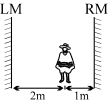
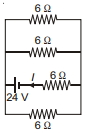
Image formed on the retina is
Five moles of helium are mixed with two moles of hydrogen to form a mixture. Take molar mass of helium $M_1=4\ g$ and that of hydrogen $M_2=2\ g$ If the internal energy of He sample of $100\,\,J$ and that of the hydrogen sample is $200\,\,J$, then the internal energy of the mixture is ..... $J$