- Remain T
- Become 2T
- Become $\frac{\text{T}}{2}$
- Become $\frac{\text{T}}{\sqrt{2}}$
Explanation:
Time period (T) is given by,
$\text{T}=2\pi\sqrt{\frac{\text{m}}{\text{k}}}$
where m is the mass, and k is spring constant.
When the spring is divided into two parts, the new spring constant k1 is given as,
$\text{k}_1=2\text{k}$
New time period T1:
$\text{T}_1=2\pi\sqrt{\frac{\text{m}}{2\text{k}}}=\frac{1}{\sqrt{2}}2\pi\sqrt{\frac{\text{m}}{\text{k}}}=\frac{1}{\sqrt{2}}\text{T}$
Generate a complete, print-ready paper with questions like this in minutes — across 16+ boards, with answer keys.
Magnets A and B are geometrically similar but the magnetic moment of A is twice that of B. If T1 and T2 be the time periods of the oscillation when their like poles and unlike poles are kept together respectively, then
will be
|
(a) |
(b) |
(c) |
(d) |
A 2μF capacitor is charged to 100 volt and then its plates are connected by a conducting wire. The heat produced is
|
(a) 1 J |
(b) 0.1 J |
(c) 0.01 J |
(d) 0.001 J |
The specific resistance of manganin is
. The resistance of a cube of length 50 cm will be
|
(a) |
(b) 2.5 |
(c) |
(d) 5 |
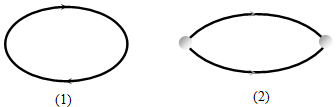
Below figures (1) and (2) represent lines of force. Which is correct statement

|
(a) Figure (1) represents magnetic lines of force |
|
(b) Figure (2) represents magnetic lines of force |
|
(c) Figure (1) represents electric lines of force |
|
(d) Both figure (1) and figure (2) represent magnetic lines of force |
The cathode rays have particle nature because of the fact that
|
(a) They can propagate in vacuum |
|
(b) They are deflected by electric and magnetic fields |
|
(c) They produced fluorescence |
|
(d) They cast shadows |