Question
A particle executes simple harmonic motion with a frequency v. The frequency with which the kinetic energy oscillates is:
- $\frac{\text{v}}{2}$
- v
- 2v
- zero
Explanation:
Because in one complete oscillation, the kinetic energy changes its value from zero to maximum, twice.
Generate a complete, print-ready paper with questions like this in minutes — across 16+ boards, with answer keys.
The wavelength of yellow line of sodium is 5896 Å. Its wave number will be
|
(a) 50883 × 1010 per second |
(b) 16961 per cm |
|
(c) 17581 per cm |
(d) 50883 per cm |
A parallel plate capacitor of capacitance C is connected to a battery and is charged to a potential difference V. Another capacitor of capacitance 2C is connected to another battery and is charged to potential difference 2V. The charging batteries are now disconnected and the capacitors are connected in parallel to each other in such a way that the positive terminal of one is connected to the negative terminal of the other. The final energy of the configuration is
|
(a) Zero |
(b) |
(c) |
(d) |
A light ray from air is incident (as shown in figure) at one end of a glass fiber (refractive index m = 1.5) making an incidence angle of 60o on the lateral surface, so that it undergoes a total internal reflection. How much time would it take to traverse the straight fiber of length 1 km
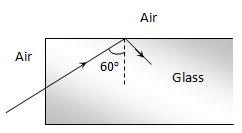
| (a) 3.33 m sec | (b) 6.67 m sec | (c) 5.77 m sec | (d) 3.85 m sec |
Faraday's laws are consequence of conservation of
|
(a) Energy |
(b) Energy and magnetic field |
|
(c) Charge |
(d) Magnetic field |
The idea of the quantum nature of light has emerged in an attempt to explain
|
(a) Interference |
(b) Diffraction |
|
(c) Radiation spectrum of a black body |
(d) Polarisation |
A star moves away from earth at speed 0.8 c while emitting light of frequency 6  . What frequency will be observed on the earth (in units of 1014 Hz) (c = speed of light)
|
(a) 0.24 |
(b) 1.2 |
(c) 30 |
(d) 3.3 |


