A particle executes simple harmonic oscillation with an amplitude $a.$ The period of oscillation is $T.$ The minimum time taken by the particle to travel half of the amplitude from the equilibrium position is
AIPMT 2007, Medium


Download our appand get started for free
Experience the future of education. Simply download our apps or reach out to us for more information. Let's shape the future of learning together!No signup needed.*
Similar Questions
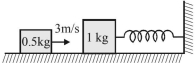
- 1A $1\,kg$ mass is attached to a spring of force constant $600\,N / m$ and rests on a smooth horizontal surface with other end of the spring tied to wall as shown in figure. A second mass of $0.5\,kg$ slides along the surface towards the first at $3\,m / s$. If the masses make a perfectly inelastic collision, then find amplitude and time period of oscillation of combined mass.View Solution
- 2The amplitude of an oscillating simple pendulum is $10\,cm$ and its period is $4\, sec$. Its speed after $1\, sec$ after it passes its equilibrium position, is ... $m/s$View Solution
- 3A particle executes simple hormonic motion between $x =\, -A$ and $x = +A$ . It starts from $x = 0$ moves in $+x-$ direction. The time taken for it to move from $x = 0$ to $x = \frac {A}{2}$ is $T_1$ and to move from $\frac {A}{2}$ to $\frac {A}{\sqrt 2}$ is $T_2$ , thenView Solution
- 4The displacement $x$ (in metres) of a particle performing simple harmonic motion is related to time $t$ (in seconds) as $x = 0.05\cos \left( {4\,\pi \,t + \frac{\pi }{4}} \right)$. The frequency of the motion will be ..... $Hz$View Solution
- 5A particle is executing simple harmonic motion with a time period $T.$ At time $t = 0$, it is at its position of equilibrium. The kinetic energy-time graph of the particle will look likeView Solution
- 6The displacement of a particle along the $x-$ axis is given by $x=asin^2$$\omega t$ . The motion of the particle corresponds toView Solution
- 7A simple pendulum is executing simple harmonic motion with a time period $T$. If the length of the pendulum is increased by $21\%$, the percentage increase in the time period of the pendulum of increased length is ..... $\%$View Solution
- 8Two small bodies of mass of $2\, kg$ each attached to each other using a thread of length $10\, cm$, hang on a spring whose force constant is $200\, N/m$, as shown in the figure. We burn the thread. What is the distance between the two bodies when the top body first arrives at its highest position .... $cm$ ? (Take $\pi^2 = 10$)View Solution

- 9A particle of mass $10\, gm$ moves in a field where potential energy per unit mas is given by expression $v = 8 \times 10^4\, x^2\, erg/gm$. If the total energy of the particle is $8 \times 10^7\, erg$ then the relation between $x$ and time $t$ isView Solution
- 10A particle in $SHM $ is described by the displacement equation $x(t) = A\cos (\omega t + \theta ).$ If the initial $(t = 0)$ position of the particle is $1 \,cm$ and its initial velocity is $\pi $cm/s, what is its amplitude? The angular frequency of the particle is $\pi {s^{ - 1}}$View Solution