MCQ
A particle executing simple harmonic motion with amplitude of $0.1 m$. At a certain instant when its displacement is $0.02 m$, its acceleration is 0.5 $m / s$. The maximum velocity of the particle is (in $m / s$ )
  • A
    0.01
  • B
    0.05
  • 0.5
  • D
    0.25

Answer

Correct option: C.
0.5
(c)$\begin{aligned}& \text { Acceleration } A=\omega^2 y \Rightarrow \omega=\sqrt{\frac{A}{y}}=\sqrt{\frac{0.5}{0.02}}=5 \\& \text { Maximum velocity } v_{\max }=a \omega=0.1 \times 5=0.5\end{aligned}$

Need a full question paper?

Generate a complete, print-ready paper with questions like this in minutes — across 16+ boards, with answer keys.
Start Generating Free

Similar questions

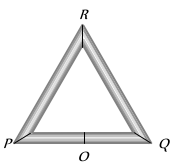
Three rods of equal length $I$ are joined to form an equilateral triangle $P Q R$. $O$ is the mid point of $P Q$. Distance $O R$ remains same for small change in temperature. Coefficient of linear expansion for $P R$ and $R Q$ is same i.e. $\alpha_2$ but that for $P Q$ is $\alpha_1$. Then
Image
A jet engine works on the principle of
For an ideal gas, in an isothermal process
A transparent cube of $15 \mathrm{~cm}$ edge contains a small air bubble. Its apparent depth when viewed through one face is $6 \mathrm{~cm}$ and when viewed through the opposite face is $4 \mathrm{~cm}$. Then the refractive index of the material of the cube is
A cylinder of radius $R$ made of a material of thermal conductivity $K_1$ is surrounded by a cylindrical shell of inner radius $R$ and outer radius $2 R$ made of material of thermal conductivity $K_2$. The two ends of the combined system are maintained at two different temperatures. There is no loss of heat across the cylindrical surface and the system is in steady state. The effective thermal conductivity of the system is
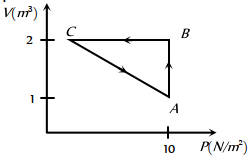
An ideal gas is taken through the cycle $A \rightarrow B \rightarrow C \rightarrow A$, as shown in the figure. If the net heat supplied to the gas in the cycle is $5 \mathrm{~J}$, the work done by the gas in the process $C \rightarrow A$ is
The dimension of the ratio of angular to linear momentum is
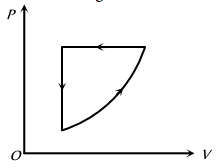
For one complete cycle of a thermodynamic process on a gas as shown in the $P-V$ diagram, Which of following is correct
Image
A car travels north with a uniform velocity. It goes over a piece of mud which sticks to the tyre. The particles of the mud, as it leaves the ground are thrown
Two identical samples of a gas are allowed to expand $(i)$ isothermally $(ii)$ adiabatically. Work done is