MCQ
A particle experiences a constant acceleration for $20\, seconds$ after starting from rest. If it travels a distance $s_1$ in the first $10\, seconds$ and distance $s_2$ in the next $10\, seconds$, then :-
  • A
    $s_2 = s_1$
  • B
    $s_2 = 2s_1$
  • $s_2 = 3s_1$
  • D
    $s_2 = 4s_1$

Answer

Correct option: C.
$s_2 = 3s_1$
c
As acceleration is constant for 20 sec after starting from rest so

$\mathrm{S} 1=\mathrm{ut}+1 / 2 \times \mathrm{at}^{\wedge} 2$

$\mathrm{S} 1=0 \times 10+1 / 2 \times \mathrm{a} \times 100$

$\mathrm{So}, \mathrm{S} 1=50 \mathrm{a}$

Now, $\mathrm{S} 1+\mathrm{S} 2=0 \times 20+1 / 2 \times \mathrm{a} \times 20^{\wedge} 2$

$\mathrm{S} 1+\mathrm{S} 2=200 \mathrm{a}$

As, $\mathrm{S} 1=50 \mathrm{a}$

$50 a+52=200 a$

$\mathrm{S} 2=150 \mathrm{a}$

Hence $\mathrm{S} 1 / \mathrm{S} 2=50 \mathrm{a} / 150 \mathrm{a}$

$\mathrm{S} 2=3 \mathrm{S} 1$
Need a full question paper?

Generate a complete, print-ready paper with questions like this in minutes — across 16+ boards, with answer keys.

Start Generating Free

Similar questions

A particle moves in the $xy$ -plane with velocity $u_x = 8t -2$ and $u_y = 2$. If it passes through  the point $(14, 4)$ at $t = 2\, s$, the equation of its path is 
Two waves are given by ${y_1} = a\sin (\omega t - kx)$ and ${y_2} = a\cos (\omega \,t - kx)$ The phase difference between the two waves is
A galvanometer having a resistance of $9\, ohm$ is shunted by a wire of resistance $2\, ohm$. If the total current is $1\, amp$, the part of it passing through the shunt will be ............ $amp$
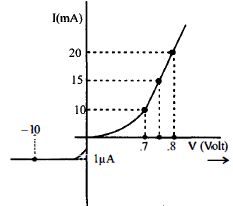
The $V-I$ characteristic of a diode is shown in the figure. The ratio of forward to reverse bias resistance is
A charged particle enters a magnetic field $H$ with its initial velocity making an angle of $45^\circ $ with $H$. The path of the particle will be
An electron of a hydrogen like atom, having $Z=4$, jumps from $4^{\text {th }}$ energy state to $2^{\text {nd }}$ energy state, The energy released in this process, will be $.........eV$

$($ Given $Rch =13.6\,eV )$

Where $R =$ Rydberg constant

$c=$ Speed of light in vacuum

$h =$ Planck's constant

The ionisation energy of hydrogen atom is $13.6\; eV$, the ionisation energy of a singly ionised helium atom would be  ....... $eV$
If the mass of a radioactive sample is doubled, the activity of the sample and the disintegration constant of the sample are respectively
For measurement of potential difference, potentiometer is preferred in comparison to voltmeter because
A black body has maximum wavelength ${\lambda _m}$ at temperature $2000\; K$. Its corresponding wavelength at temperature $3000 \;K$ will be