MCQ
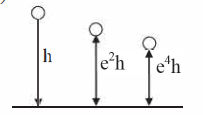
A particle falls from a height h on a fixed horizontal surface and rebounds. If e is the coefficient of restitution, then the total distance travelled by the particle before it stops rebounding is
  • $\frac{ h \left(1+ e ^2\right)}{\left(1- e ^2\right)}$
  • B
    $\frac{ h \left(1- e ^2\right)}{\left(1+ e ^2\right)}$
  • C
    $\frac{ h \left(1- e ^2\right)}{2\left(1+ e ^2\right)}$
  • D
    $\frac{ h \left(1+ e ^2\right)}{2\left(1- e ^2\right)}$
Answer

Correct option: A.
$\frac{ h \left(1+ e ^2\right)}{\left(1- e ^2\right)}$
(A)
Image
Total distance $=h+2 e^2 h+2 e^4 h \ldots$.
$=h+2 e^2 h\left(1+e^2+\ldots\right)$
Using binomial expansion,
$\left(1+ e ^2+ e ^4+\ldots\right)=\frac{1}{\left(1- e ^2\right)}$
$= h +\frac{2 e ^2 h}{1- e ^2}$
$=\frac{ h - e ^2 h+2 e ^2 h}{\left(1- e ^2\right)}$
$=\frac{ h \left(1+ e ^2\right)}{\left(1- e ^2\right)}$

Need a full question paper?

Generate a complete, print-ready paper with questions like this in minutes — across 16+ boards, with answer keys.

Start Generating Free

Similar questions

The magnetic dipole moment has dimensions of
Which of the following is the fundamental unit?
A magnetic dipole has magnetic length 10 cm and pole strength 100 Am. Its magnetic dipole moment is ………………. Am².
Calculate angular velocity of earth so that acceleration due to gravity at $60^{\circ}$ latitude becomes zero. (Radius of earth $=6400 km$, gravitational acceleration at poles $=10 m / s ^2, \cos 60^{\circ}=0.5$ )
A satellite is orbiting around a planet at a constant height in a circular orbit. If the mass of the planet is reduced to half, the satellite would
The v-t graph of a particle moving with variable acceleration is given below. Which of the following statement is correct?
Image
The force 'F' acting on a particle of mass 'm' is indicated by the force-time graph shown below. The change in momentum of the particle over the time interval from zero to 8 s is -
Image
A ball of mass 0.15 kg is dropped from a height 10 m, strikes the ground and rebounds to the same height. The magnitude of impulse imparted to the ball is $\left( g =10 m / s ^2\right)$ nearly:
The centre of mass of a system of three particles of masses 1 g, 2 g and 3 g is taken as the origin of a coordinate system. The position vector of a fourth particle of mass 4 g such that the centre of mass of the four particle system lies at the point (1, 2, 3) is $\alpha(\hat{i}+2 j+3 \hat{k})$, where $\alpha$ is a constant. The value of $\alpha$ is
Two particles of masses $m _1$ and $m _2$ have equal kinetic energies. The ratio their momenta is