MCQ
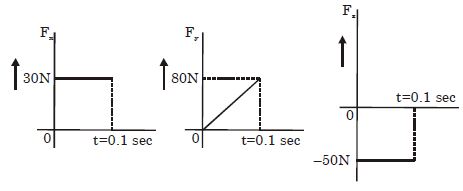
A particle is acted upon by a force whose  component's variations with time are shown in diagrams. Then the magnitude of change in momentum of the particle in $0.1\,\,sec$ will be :-
  • A
    $2\,\,kg\, m\,/\,sec$
  • B
    $10\,\,kg\, m\,/\,sec$
  • C
    $12\,\,kg\, m\,/\,sec$
  • $5\sqrt 2\,\,kg\, m\,/\,sec$

Answer

Correct option: D.
$5\sqrt 2\,\,kg\, m\,/\,sec$
d
$\Delta p_{x}=3 \mathrm{NS}$

$\Delta p_{y}=4 \mathrm{NS}$

$\Delta p_{z}=-5 N S$

$\Delta p=\sqrt{3^{2}+4^{2}+5^{2}}=5 \sqrt{2} \mathrm{NS}$

Need a full question paper?

Generate a complete, print-ready paper with questions like this in minutes — across 16+ boards, with answer keys.

Start Generating Free

Similar questions

Two skaters $A$ and $B$ of weights in the ratio $5 : 7$ start facing each other $6\,metres$ apart on a horizontal smooth surface. They pull on a rope stretched between them. How far has each moved when they meet?
The escape velocity of a body from the earth is ve. If the radius of earth contracts to $\frac{1}{4}\text{th}$ of its value, keeping the mass of the earth constant, escape velocity will be:
A solid sphere, a hollow sphere and a disc, all having same mass and radius, are placed at the top of a smooth incline and released. Least time will be taken in reaching the bottom by:
  1. The solid sphere.
  2. The hollow sphere.
  3. The disc.
  4. All will take same time.
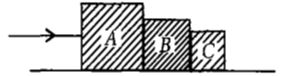
Three blocks $A, B$ and $C,$ of masses $4\, kg, \,2 \,kg$ and $1\, kg$ respectively, are in contact on a frictionless surface, as shown. If a force of $14\, N$ is applied on the $4 \,kg$ block, then the contact force between $A$ and $B$ is  .......... $N$
If the system is released, then the acceleration of the centre of mass of the system is
$150 \,g$ of ice is mixed with $100 \,g$ of water at temperature $80^{\circ} C$. The latent heat of ice is $80 cal / g$ and the specific heat of water is $1 cal / g ^{\circ} C$. Assuming no heat loss to the environment, the amount of ice which does not melt is ........... $g$
The magnitude of torque on a particle of mass $1\,kg$ is $2.5\, Nm$ about the origin. If the force acting on it is $1\,N$, and the distance of the particle from the origin is $5\,m$, the angle between the force and the position vector is (in radians)
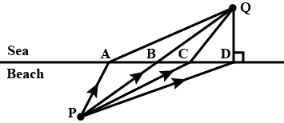
A girl standing at point $P$ on a beach wishes to reach a point $Q$ in the sea as quickly as possible. She can run at $6 \,kmh ^{-1}$ on the beach and swim at $4 \,kmh ^{-1}$ in the sea. She should take the path
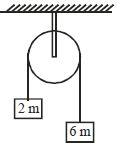
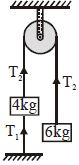
Two bodies of mass $4\,kg$ and $6\,kg$ are attached to the ends of a string passing over a pulley. A $4\,kg$ mass is attached to the table top by another string. The tension in this string $T_1$ is equal to ......... $N$
A particle is moving on a circular path with constant speed, then its acceleration will be