MCQ
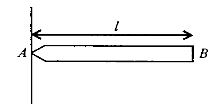
A particle is in linear simple harmonic motion between two points $A$ and $B, 10\ cm$ apart Take the direction from $A$ to $B$ as the $+ ve$ direction and choose the correct statements:

  • A
    The sign of velocity, acceleration and force on the particle when it is $3\ cm$ away from $A$ going towards $B$ are positive.
  • B
    The sign of acceleration and force on the particle when it is at point $B$ is negative.
  • C
    The sign of velocity, acceleration and force on the particle when it is $4\ cm$ away from $B$ going towards $A$ are negative.
  • All of the above

Answer

Correct option: D.
All of the above
  1. when the particle is going from $A$ to $B (+ve$ direction$)$ and it is $3 \ cm$ from $A$ velocity increases up to $O$ so velocity is positive. Acceleration in $\text{SHM}$ is towards $+ve.$ So both $v$ and a are $+ve.$
  2. As the particle is going towards $B$ so velocity is Positive not negative.
  3. As the particle is at $4\ cm$ from $B$ and $B$ and going towards $A$ i.e. $(-)ve$ side, so velocity and acceleration towards mean position at $O$. So both are negative.
  4. When particle is at $B$ force and acceleration both are towards $'O\ '$, so both are negative.

Need a full question paper?

Generate a complete, print-ready paper with questions like this in minutes — across 16+ boards, with answer keys.

Start Generating Free

Similar questions

The two interfering waves have intensities in the ratio $9 : 4$. The ratio of intensities of maxima and minima in the interference pattern will be
When two progressive waves $\mathrm{y}_1=4 \sin (2 \mathrm{x}-6 \mathrm{t})$ and $\mathrm{y}_2=3 \sin \left(2 \mathrm{x}-6 \mathrm{t}-\frac{\pi}{2}\right)$ are superimposed, the amplitude of the resultant wave is
A uniform rod $AB$ of length $l$ and mass $m$ is free to rotate about point $A.$ The rod is released from rest in the horizontal position. Given that the moment of inertia of the rod about $A$ is $ml^2/3$, the initial angular acceleration of the rod will be 
One projectile moving with velocity $v$ in space, gets burst into $2$ parts of masses in the ratio $1 : 3$ . The smaller part becomes stationary. What is the velocity of the other part ?
There is a destructive interference between the two waves of wavelength $\lambda$ coming from two different paths at a point. To get maximum sound or constructive interference at that point, the path of one wave is to be increased by
A sphere $P$ of mass $m$ and moving with velocity $v$ undergoes an oblique and  perfectly elastic collision with an identical sphere $Q$ initially at rest. The angle $\theta$ between the velocities of the spheres after the collision shall be .............. $^o$
A particle moves in a circular orbit under the action of a central attractive force inversely proportional to the distance $'r'$. The speed of the particle is
A student sitting at the top of a tree has $............$ than the student who is sitting on the ground.
What is the velocity of a metallic ball of radius $r$ falling in a tank of liquid at the instant when its acceleration is one half that of a freely falling body? $($The densities of metal and of liquid are $\rho$ and $\sigma$ respectively and of viscosity of liquid is $\eta)$
Two generators $S_1$ and $S_2$ produce water wave of equal frequency. A point $P$ is located such that $(S_1P -S_2P)$ is equal to half a wavelength. When operated alone, $S_1$ produces an oscillation of amplitude $2a$ at $P$ while $S_2$ produces an oscillation of amplitude $a$ . If the generators are operated in phase, which graph correctly shows the resultant oscillation at $P$ ?