Question
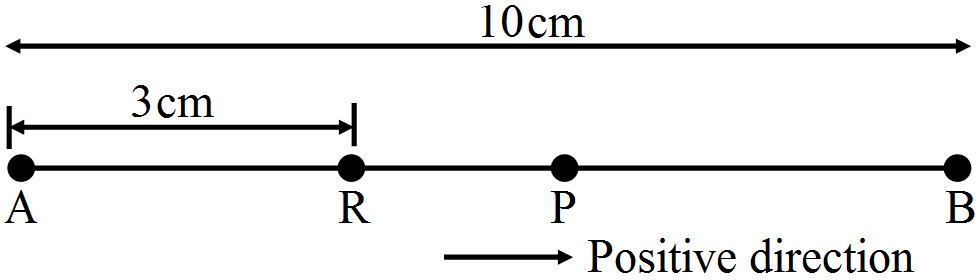
A particle is in linear simple harmonic motion between two points $A$ and $B, 10\ cm$ apart. Take the direction from $A$ to $B$ as positive direction and give the signs of velocity and acceleration on the particle when it is :
  1. At the end $B$.
  2. At $3\ cm$ away from $A$ going towards $B$.
Answer


  1. At the end $B$ velocity is zero. Here acceleration and force are negative as they are directed along $BR$ i.e., along negative direction.
  2. At $3\ cm$ away from $A$ going towards $B$, the particle is at $R$, with a tendency to move along $RP$ which is positive direction, here velocity, acceleration are all positive.

Need a full question paper?

Generate a complete, print-ready paper with questions like this in minutes — across 16+ boards, with answer keys.

Start Generating Free

Similar questions

A coil of inductance $5.0\ mH$ and negligible resistance is connected to the oscillator of the previous problem. Find the peak currents in the circuit for $\omega=100\text{s}^{-1},500\text{s}^{-1},1000\text{s}^{-1}.$
A certain sample of a radioactive material decays at the rate of $500$ per second at a certain time. The count rate falls to $200$ per second after $50$ minutes.
  1. What is the decay constant of the sample?
  2. What is its half$-$life?
The principle of ‘parallax’ in section $2.3.1$ is used in the determination of distances of very distant stars. The baseline AB is the line joining the Earth’s two locations six months apart in its orbit around the Sun. That is, the baseline is about the diameter of the Earth’s orbit $\approx 3 \times 10^{11} \mathrm{~m}$. However, even the nearest stars are so distant that with such a long baseline, they show parallax only of the order of $1”$ (second) of arc or so. A parsec is a convenient unit of length on the astronomical scale. It is the distance of an object that will show a parallax of $1”$ (second of arc) from opposite ends of a baseline equal to the distance from the Earth to the Sun. How much is a parsec in terms of metres?
A particle executes the motion described by $\text{x}(\text{t})=\text{x}_0(1-\text{e}^{-\gamma\text{t}});\text{t}\ge0,\text{x}_0>0.$
Where does the particle start and with what velocity?
A solid sphere of radius 10 cm is subjected to a uniform pressure equal to $5 \times 10^8 \mathrm{Nm}^{-2}$. Calculate the change in volume. Bulk modulus of the material of the sphere is $3.14 \times 10^{11} \mathrm{Nm}^{-2}$.
A long, cylindrical tube of inner and outer radii $a$ and $b$ carries a current $i$ distributed uniformly over its cross section. Find the magnitude of the magnetic field at a point $(a)$ just inside the tube $(b)$ just outside the tube.
A dumb-bell consists of two identical small balls of mass $\frac{1}{2}\text{kg}$ each connected to the two ends of a 50cm long light rod. The dumb-bell is rotating about a fixed axis through the centre of the rod and perpendicular to it at an angular speed of 10rad/s. An impulsive force of average magnitude 5.0N acts on one of the masses in the direction of its velocity for 0.10s. Find the new angular velocity of the system.
The photograph of a house occupies an area of $1.75cm^2$ on a $35mm$ slide. The slide is projected on to a screen, and the area of the house on the screen is $1.55m^2$. What is the linear magnification of the projector-screen arrangement.
Figure, shows a copper rod joined to a steel rod. The rods have equal length and equal cross sectional area. The free end of the copper rod is kept at $0^{\circ} \mathrm{C}$ and that of the steel rod is kept at $100^{\circ} \mathrm{C}$. Find the temperature at the junction of the rods. Conductivity of copper $=390 \mathrm{Wm}^{-1^\circ} \mathrm{C}^{-1}$. and that of steel $=46 \mathrm{Wm}^{-1^\circ} \mathrm{C}^{-1}$.
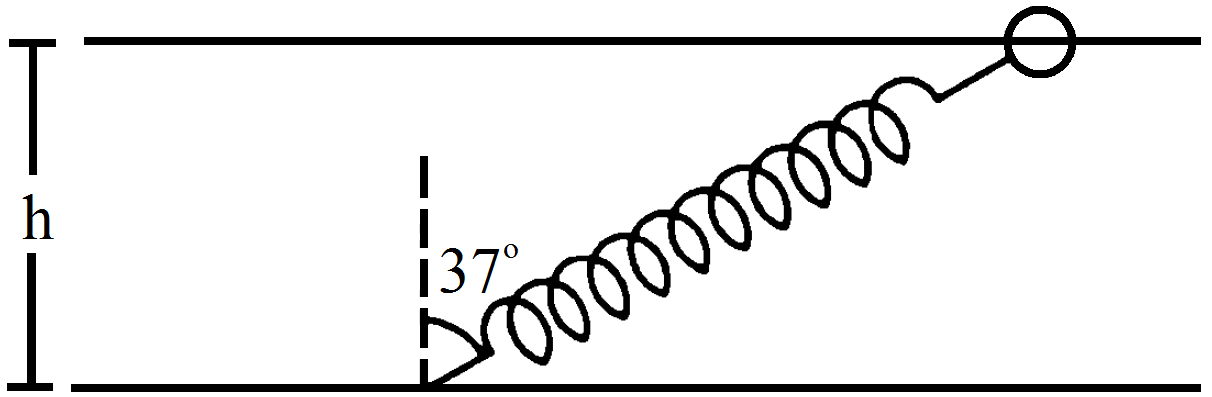
One end of a spring of natural length h and spring constant k is fixed at the ground and the other is fitted with a smooth ring of mass m which is allowed to slide on a horizontal rod fixed at a height h (figure). Initially, the spring makes an angle of 37° with the vertical when the system is released from rest. Find the speed of the ring when the spring becomes vertical.