Question
A particle is in linear simple harmonic motion between two points A and B, 10cm apart Take the direction from A to B as the + ve direction and choose the correct statements:

  1. The sign of velocity, acceleration and force on the particle when it is 3cm away from A going towards B are positive.
  2. The sign of velocity of the particle at C going towards O is negative.
  3. The sign of velocity, acceleration and force on the particle when it is 4cm away from B going towards A are negative.
  4. The sign of acceleration and force on the particle when it is at point B is negative.
Answer

  1. The sign of velocity, acceleration and force on the particle when it is 3cm away from A going towards B are positive.
  1. The sign of velocity, acceleration and force on the particle when it is 4cm away from B going towards A are negative.
  1. The sign of acceleration and force on the particle when it is at point B is negative.

Explanation:

  1. when the particle is going from A to B (+ve direction) and it is 3 cm from A velocity increases up to O so velocity is positive. Acceleration in SHM is towards +ve. So both v and a are +ve.
  2. As the particle is going towards B so velocity is Positive not negative.
  3. As the particle is at 4cm from B and B and going towards A i.e. (-)ve side, so velocity and acceleration towards mean position at O. So both are negative.
  4. When particle is at B force and acceleration both are towards ‘O’, so both are negative.

Need a full question paper?

Generate a complete, print-ready paper with questions like this in minutes — across 16+ boards, with answer keys.

Start Generating Free

Similar questions

The pressure and volume of saturated water vapour are $P$ and $V$ respectively. It is compressed isothermally thereby volume becomes $V/2,$ the final pressure will be
The negative value of work done by a conservative internal force on a system is equal to:
A wheel of radius 20cm is pushed to move it on a rough horizontal surface. It is found to move through a distance of 60cm on they road during the time it completes one revolution about the centre. Assume that the linear and the angular accelerations are uniform. The frictional force acting on the wheel by the surface is:
A ball is thrown vertically downwards from a height of  $20\, m$ with an initial velocity $v_0$, It collides with the ground, loses $50$ percent of its energy in collision and rebounds same height. The initial velocity $v_0$ .................... $\mathrm{ms}^{-2}$ (Take $g=10 \,ms^{-2}$)
A person walks up a stalled escalator in $90 s$. When just standing on the same moving escalator, he is carried in $60 s$. The time it would take him to walk up the moving escalator will be $.......\,s$
The amplitude of a particle executing $S.H.M.$ with frequency of $60 \,Hz$ is $0.01 \,m$. The maximum value of the acceleration of the particle is
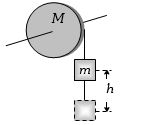
A massless string is wrapped round a disc of mass $M$ and radius $R$. Another end is tied to a mass $m$ which is initially at height $h$ from ground level as shown in the fig. If the mass is released then its velocity while touching the ground level will be
If time of flight of a projectile is $10$ seconds. Range is $500$ meters. The maximum height attained by it will be  ......... $m$
Find time of flight of projectile thrown horizontally with speed $50 ms^{^{-1}}$ from a long inclined plane which makes an angle of $\theta = 45^o$ from horizontal  ........ $\sec$
A physical quantity $\vec{S}$ is defined as $\vec{S}=(\vec{E} \times \vec{B}) / \mu_0$, where $\vec{E}$ is electric field, $\vec{B}$ is magnetic field and $\mu_0$ is the permeability of free space. The dimensions of $\vec{S}$ are the same as the dimensions of which of the following quantity (ies)?

$(A)$ $\frac{\text { Energy }}{\text { charge } \times \text { current }}$

$(B)$ $\frac{\text { Force }}{\text { Length } \times \text { Time }}$

$(C)$ $\frac{\text { Energy }}{\text { Volume }}$

$(D)$ $\frac{\text { Power }}{\text { Area }}$