Question
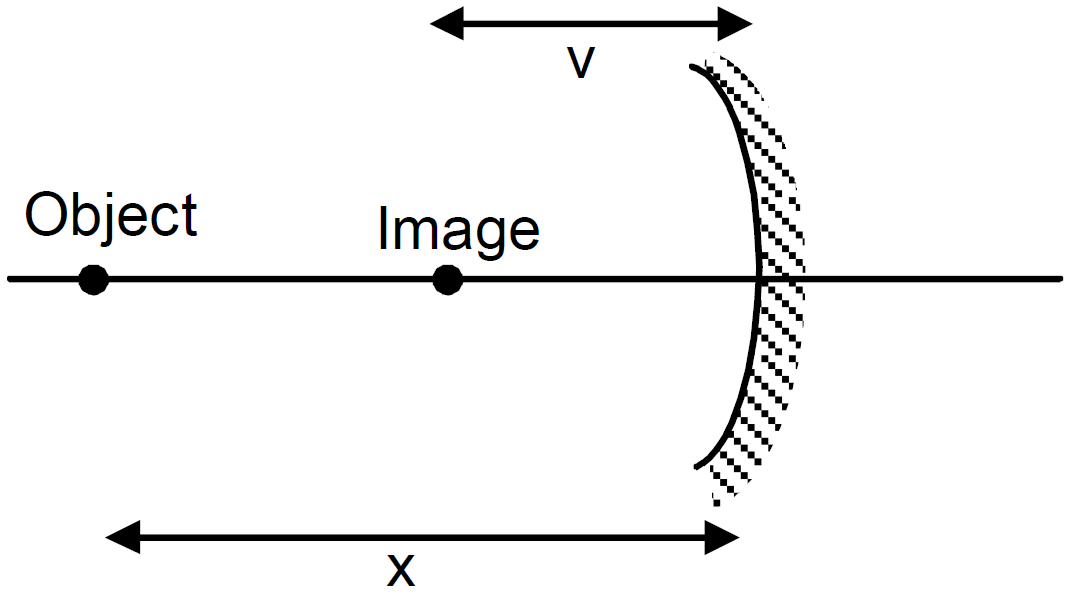
A particle is moving at a constant speed V from a large distance towards a concave mirror of radius R along its principal axis. Find the speed of the image formed by the mirror as a function of the distance x of the particle from the mirror.
Answer

Given that, u = distance of the object = -x f = focal length $=-\frac{\text{R}}{2}$ and, V = velocity of object $=\frac{\text{dx}}{\text{dt}}$ From mirror equation, $\frac{1}{-\text{x}}+\frac{1}{\text{v}}=-\frac{2}{\text{R}}$$\frac{1}{\text{v}}=-\frac{2}{\text{R}}+\frac{1}{\text{x}}=\frac{\text{R}-2\text{x}}{\text{R}\text{x}}\Rightarrow\text{v}=\frac{\text{Rx}}{\text{R}-2\text{x}}=$ Image distance
So, velocity of the image is given by,$\text{V}_1=\frac{\text{dv}}{\text{dt}}=\frac{\Big[\frac{\text{d}}{\text{dt}}(\text{xR})(\text{R}-2\text{x})\Big]-\Big[\frac{\text{d}}{\text{dt}}(\text{R}-2\text{x})(\text{xR})\Big]}{(\text{R}-2\text{x})^2}$
$=\frac{\text{R}\Big[\frac{\text{dx}}{\text{dt}}(\text{R}-2\text{x})\Big]-\Big[-2\frac{\text{d}}{\text{dt}}\text{x}\Big]}{(\text{R}-2\text{x})^2}=\frac{\text{R}[\text{v}(\text{R}-2\text{x})+2\text{vx}0}{(\text{R}-2\text{x})^2}$
$=\frac{\text{VR}^2}{(2\text{x}-\text{R})^2}=\frac{\text{R}\big[\text{VR}-2\text{xV}\big)+2\text{xV}}{(\text{R}-2\text{x})^2}$

Need a full question paper?

Generate a complete, print-ready paper with questions like this in minutes — across 16+ boards, with answer keys.

Start Generating Free

Similar questions

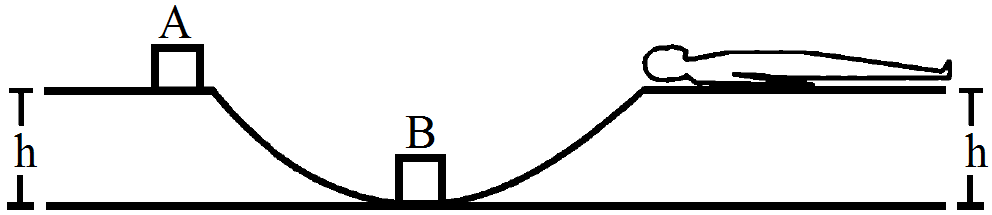
The track shown in figure is frictionless. The block B of mass $2m$ is lying at rest and the block A of mass m is pushed along the track with some speed. The collision between A and B is perfectly elastic. With what velocity should the block A be started to get the sleeping man awakened?
A faulty barometer contains certain amount of air and saturated water vapour. It reads 74.0cm when the atmospheric pressure is 76.0cm of mercury and reads 72.10cm when the atmospheric pressure is 74.0cm of mercury. Saturation vapour pressure at the air temperature = 1.0cm of mercury. Find the length of the barometer tube above the mercury level in the reservoir
Draw a graph to show the variation of P.E., K.E. and total energy of a simple harmonic oscillator with displacement.
Particles of masses 1g, 2g, 3g, ........, 100g are kept at the marks 1cm, 2cm, 3cm, ........, 100cm respectively on a metre scale. Find the moment of inertia of the system of particles about a perpendicular bisector of the metre scale.
A gas mixture consists of molecules of $A, B$ and $C$ with masses $m_A > m_B > m_c$. Rank the three types of molecules in decreasing order of (a) average KE, (b) rms speeds.
A square-shaped copper coil has edges of length 50cm and contains 50 turns. It is placed perpendicular to a 1.0T magnetic field. It is removed from the magnetic field in 0·25s and restored in its original place in the next 0·25s. Find the magnitude of the average emf induced in the loop during:
  1. Its removal.
  2. Its restoration.
  3. Its motion.
A battery of emf 100V and a resistor of resistance $10\text{k}\Omega$ are joined in series. This system is used as a source to supply current to an external resistance R. If R is not greater than $100\Omega,$ the current through it is constant up to two significant digits. Find its value. This is the basic principle of a constant-current source.
State Kepler's laws of planetary motion. What would be the speed of rotation of the earth in order that a body on the equator has no weight? Determine the apparent weights of the bodies situated at a latitude of $60°$ and at the poles. The radius of the earth = $6400km$ and $g = 9.8ms^{-1}$.
An object may be regarded to be at rest or in motion depending on the frame of reference chosen to view the object. Because of length contraction it would mean that the same rod may have two different lengths depending on the state of the observer. Is this true?
To simulate car accidents, auto manufacturers study the collisions of moving cars with mounted springs of different spring constants. Consider a typical simulation with a car of mass $1000 \ kg$ moving with a speed $18.0 \ km / h$ on a smooth road and colliding with a horizontally mounted spring of spring constant $5.25 \times 10^3 N m ^{-1}$. What is the maximum compression of the spring?
Consider the above Example taking the coefficient of friction, $\mu,$ to be $0.5$ and calculate the maximum compression of the spring.