A particle is moving in a uniform magnetic field, then
Easy
Download our app for free and get started
(a) The charged particle moving in a magnetic field does not gain energy. However, the direction of its velocity changes continuously. Hence momentum changes.
Download our app
and get started for free
Experience the future of education. Simply download our apps or reach out to us for more information. Let's shape the future of learning together!No signup needed.*
A uniform magnetic field of $2 \times 10^{-3} \mathrm{~T}$ acts along positive $\mathrm{Y}$-direction. A rectangular loop of sides $20$ $\mathrm{cm}$ and $10 \mathrm{~cm}$ with current of $5 \mathrm{~A}$ is $\mathrm{Y}-\mathrm{Z}$ plane. The current is in anticlockwise sense with reference to negative $\mathrm{X}$ axis. Magnitude and direction of the torque is :
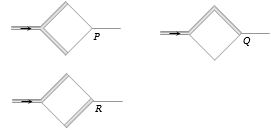
To produce a uniform magnetic field directed parallel to a diameter of a cylindrical region, one can use the saddle coils illustrated in figure. The loops are wrapped over a somewhat flattened tube. Assume the straight sections of wire are very long. The end view of the tube shows how the windings are applied. The overall current distribution is the superposition of two overlapping,circular cylinders of uniformly distributed current, one toward you and one away from you. The current density $J$ is the same for each cylinder. The position of the axis of one cylinder is described by a position vector a relative to the other cylinder. The magnetic field inside the hollow tube is.
A galvanometer $G$ deflects full scale when a potential difference of $0.50 $ $V$ is applied. The internal resistance of the galvanometer $r_g$ is $25$ $ohms$. An ammeter is constructed by incorporating the galvanometer and an additional resistance $R_S$. The ammeter deflects full scale when a measurement of $2.0$ $A$ is made. The resistance $R_S$ is closest to : ................. $\Omega$
A moving coil galvanometer of resistance $100 \,\Omega$ is used as an ammeter using a resistance $0.1 \,\Omega$. The maximum deflection current in the galvanometer is $100\,\mu A$. Find the minimum current in the circuit so that the ammeter shows maximum deflection ............... $mA$
Two similar coils are kept mutually perpendicular such that their centres coincide. At the centre, find the ratio of the magnetic field due to one coil and the resultant magnetic field by both coils, if the same current is flown
The correct curve between the magnetic induction $(b)$ along the axis of a long solenoid due to current flow $ i$ in it and distance $x$ from one end is
A $50\,\Omega $ resistance is connected to a battery of $5\,V$. A galvanometer of resistance $100\, \Omega $ is to be used as an ammeter to measure current through the resistance, for this a resistance $r_s$ is connected to the galvanometer. Which of the following connections should be employed if the measured current is within $1\% $ of the current without the ammeter in the circuit ?
$A$ and $B$ are two concentric circular conductors of centre $O$ and carrying currents ${i_1}$ and ${i_2}$ as shown in the adjacent figure. If ratio of their radii is $1 : 2$ and ratio of the flux densities at $O$ due to $A$ and $B$ is $1 : 3$, then the value of ${i_1}/{i_2}$ is
Two ions have equal masses but one is singly ionized and second is doubly ionized. They are projected from the same place in a uniform transverse magnetic field with same velocity then:
$(a)$ Both ions will go along circles of equal radii
$(b)$ The radius of circle described by the single ionized charge is double of radius of circle described by doubly ionized charge
$(c)$ Both circle do not touches to each other
$(d)$ Both circle touches to each other