MCQ
A particle is moving on a circular path with constant speed, then its acceleration will be
  • A
    Zero
  • B
    External radial acceleration
  • Internal radial acceleration
  • D
    Constant acceleration

Answer

Correct option: C.
Internal radial acceleration
c
(c)In uniform circular motion, acceleration causes due to change in direction and is directed radially towards centre.

Need a full question paper?

Generate a complete, print-ready paper with questions like this in minutes — across 16+ boards, with answer keys.
Start Generating Free

Similar questions

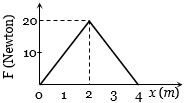
The graph between the resistive force $ F$ acting on a body and the distance covered by the body is shown in the figure. The mass of the body is $25\, kg$ and initial velocity is $2\, m/s$. When the distance covered by the body is $4m$, its kinetic energy would be .............. $\mathrm{J}$
Statement$-1$ : Real gas approaches ideal gas behaviour for low pressures and high temperatures.
statement$-2 $: At low pressure, density of gas is very low.
Ionization energy of a hydrogen$-$like ion $A$ is greater than that of another hydrogen$-$like ion $B$. Let $r, u, E$ and $L$ represent the radius of the orbit, speed of the electron, energy of the atom and orbital angular momentum of the electron respectively. In ground state:
A hollow sphere made of metal is filled with water and hung by a long thread. A tiny hole has been made in the bottom through which water slowly seeps out. Now if the sphere is made to oscillate, then its time period :
Two sitar strings, $A$  and $B,$  playing the note $'Dha'$  are slightly out of tune and produce beats and frequency  $5\,Hz.$  The tension of the string $B$ is slightly increased and the beat frequency is found to decrease by  $3\,Hz$ . If the frequency of $A$ is $425\,Hz,$  the original frequency of $B$ is  ... $Hz$
Two bodies of masses $2m$ and $m$ have their K.E. in the ratio $8 : 1$, then their ratio of momenta is
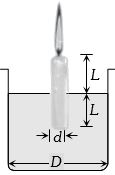
A candle of diameter $ d$ is floating on a liquid in a cylindrical container of diameter $D $  $(D>>d)$  as shown in figure. If it is burning at the rate of $2$ cm/hour then the top of the candle will
Let $F, F_N$ and f denote the magnitudes of the contact force, normal force and the friction exerted by one surface on the other kept in contact. If none of these is zero:
  1. $F > F_N$
  2. $F > f$
  3. $F_N> f$
  4. $F_N - f < F < F_N+ f$
Consider a planet in some solar system which has a mass double the mass of earth and density equal to the average density of earth. If the weight of an object on earth is ${W}$, then weight of the same object on that planet will be
If a particle covers half the circle of radius R with constant speed then